
There’s a golfer I meet some version of nearly every week. He lives in Doylestown, or Furlong, or out toward Buckingham. He plays thirty rounds a summer — a standing Saturday game, a couple of charity scrambles, a buddies trip in the fall. He owns good clubs. He watches golf on television. He has genuinely never had a formal lesson in his life.
And he has shot roughly the same score for six years.
Not a bad score. Somewhere in the 90s, occasionally high 80s when the putter cooperates. But the same score. Six years of Saturdays, six years of range balls beaten before the round, six years of that same tired joke on the first tee about how he needs to get his slice looked at one of these days.
If you’re searching for golf lessons in Bucks County, PA, the honest answer I can give you — and I’d rather be honest than convenient — is that your best year-round option may sit just over the county line. I’ll explain why that’s a feature rather than a compromise, and I’ll make the case plainly enough that you can judge it for yourself.
My name is David C. Smith Jr.. I’ve been a PGA of America Member since 1997, I’ve spent more than twenty years teaching and playing this game, and I teach nearly every day at Lower State Road Golf Center in North Wales — which sits right on the Montgomery/Bucks border, close enough that a good percentage of the people I work with drive in from Bucks County. DCSJr Golf Academy is based there year-round.
Here’s what I want to cover: where Bucks County golfers actually play, why instruction — not access — is the real bottleneck around here, how to beat the short Pennsylvania season, how to figure out what kind of help you genuinely need, and how to match a lesson format to the life you actually have.
One promise before we start. Most of what follows is advice you can use whether you ever call me or not. The seasonal plan works anywhere. The self-diagnostic works with any coach. If you take those two things and never pick up the phone, this article did its job.
Before we talk about lessons at all, though, it’s worth looking honestly at what the golf landscape around here actually looks like — because it’s better than people give it credit for.
What the Bucks County Golf Landscape Actually Looks Like
Let me say the thing that people in my position don’t always say first: the golf in Bucks County is good. Genuinely good. Not good-for-the-suburbs, not good-considering. Good.
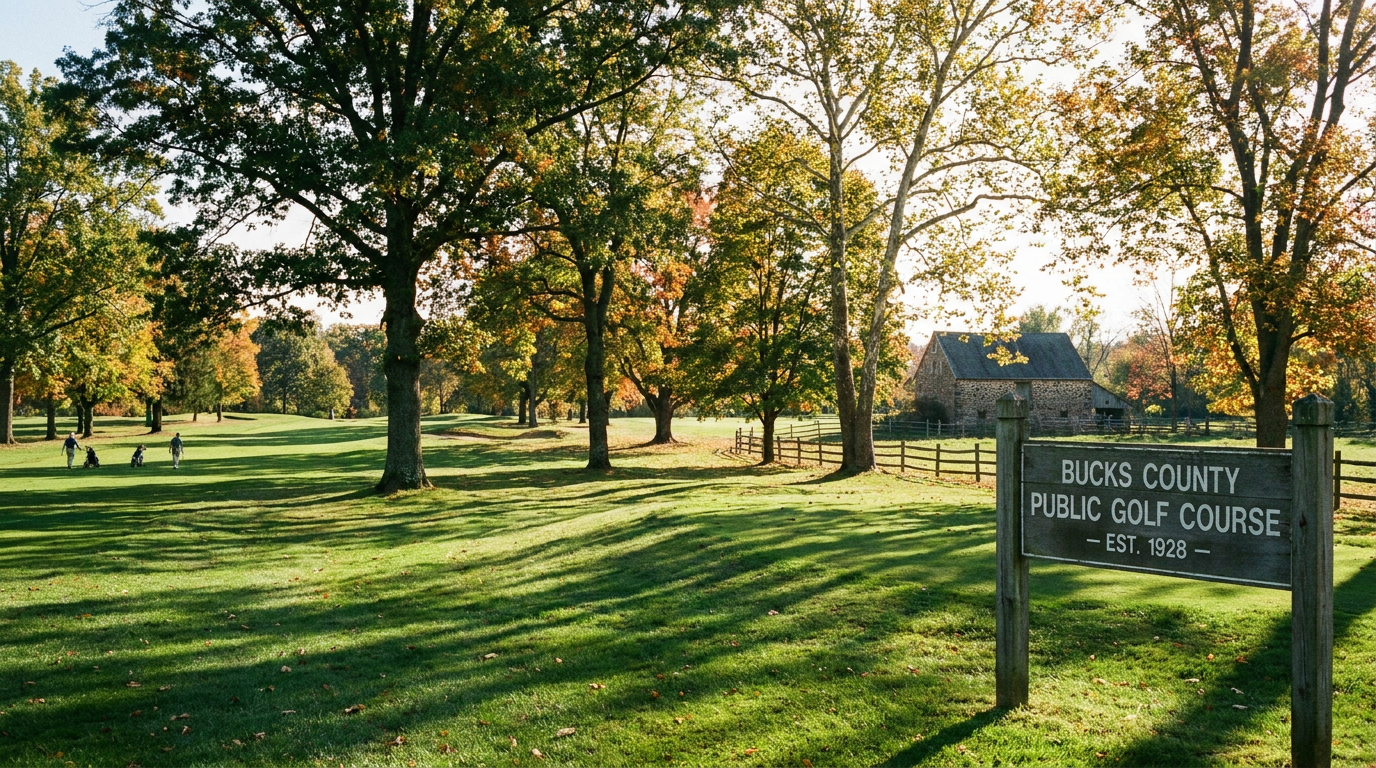
This county sits on some of the most naturally pleasant golf terrain in southeastern Pennsylvania. Head north and west — Jamison, Chalfont, Buckingham, the countryside above Doylestown — and you get gently rolling ground, mature hardwoods, old stone walls, creeks that wander through properties that were farms within living memory. Head south toward the Delaware River plain around Oxford Valley and Fairless Hills and the land flattens out considerably, opening up into something quicker and more forgiving.
That variety matters more than golfers realize. It means a player in central Bucks can drive twenty-five minutes in one direction for a scenic, undulating, think-your-way-around test, then drive twenty-five minutes the other way for a flat, fast, walk-it-in-two-hours round. Not every county gives you that.
The Courses Bucks County Golfers Actually Play
The style of golf here is overwhelmingly parkland. Tree-lined fairways, defined bunkering, water that shows up often enough to matter, greens with subtle contour rather than dramatic tiering. The practical consequence is that Bucks County golf rewards accuracy and course management far more than raw distance. You don’t overpower these courses. You position yourself around them.
Neshaminy Valley in Jamison is a good illustration. It plays to a par of 70 at roughly 6,000 yards from the white tees — which sounds short until you play it. The property was a dairy farm before it became a golf course in the early 1960s, and the routing kept a lot of the original landscape intact. Gently rolling, heavily wooded in places, with water in play around the creek near the fourteenth. It’s eminently walkable and it isn’t long, but placement off the tee genuinely determines your score. A golfer who hits it 260 crooked will lose to a golfer who hits it 215 straight. That’s the character of golf around here in one sentence.
Fairways in Warrington runs on the same principle by different means. It’s a William Gordon design from 1965, a short regulation layout at par 65 and roughly 4,500 yards from the middle tees, with bent grass through the tees, fairways and greens. What makes it interesting is that water comes into play on eleven of the eighteen holes. You can’t just hit driver and sort it out later. It’s a wonderful place for a relaxed round, for families, for anyone who wants to be done in a civilized amount of time.
Then there’s the county-run option. Oxford Valley Golf Course down in Fairless Hills is a nine-hole, par-31 layout measuring a shade over 2,000 yards, operated by the Bucks County Department of Parks & Recreation. It’s walking-only, flat, inexpensive, and completely unintimidating. I recommend it constantly to beginners and to parents with a newly interested kid. There is no better on-ramp into this game than a short, cheap, friendly nine holes where nobody is watching you and nothing is at stake.
Beyond those, the spread across the county is genuinely deep — Five Ponds over in Warminster if you want more yardage and more variety, Heritage Creek in Jamison for a quick relaxed nine, The Bucks Club in Jamison if you want something closer to a championship test, and a healthy mix of private clubs alongside the public rotation. Visit Bucks County maintains a useful roundup of places to golf in Bucks County that’s worth bookmarking if you’re building a summer list.
The Typical Bucks County Golfer, Described Honestly
Now let me describe the person reading this, and forgive me if I get close.
You’re busy. Time-poor in a way that has nothing to do with discipline and everything to do with a job, a commute, and a calendar that belongs mostly to other people. You play weekends, April through October. You might have a junior in the house who’s started asking to come along, or a spouse who’s mentioned they’d like to learn but doesn’t want to be the worst person on the range.
You get to the course thirty minutes early. You hit a small bucket, mostly with the driver, mostly at nothing in particular, at a pace of about one ball every eight seconds. You roll four putts, and then you tee off.
And you have improved either slowly or not at all, for years.
Here’s the uncomfortable mechanism underneath that: playing golf is not practicing golf. They feel similar. They are not. When you play, you hit one shot from one lie with one club and then walk away — and critically, you’re performing. You’re trying to score. You’re managing embarrassment and momentum and the group behind you. That’s a completely different cognitive activity than learning, and it produces almost no skill acquisition. Thirty rounds a summer will make you a more experienced version of exactly the golfer you already are.
That’s not a character flaw. It’s a structural problem, and it’s the one thing standing between most golfers around here and the scores they’re capable of shooting.
For the Players Who Want It Measured
Not everyone reading this is a casual weekend player, and I don’t want to write as though Bucks County golf is all leisure. There’s a serious competitive culture in this region.
Plenty of local golfers carry an official handicap and play in club championships, member-guests, and regional events run under the umbrella of the Golf Association of Philadelphia, one of the oldest and most respected regional golf associations in the country. If you’re the sort of player who wants improvement to be measurable rather than anecdotal, that infrastructure already exists, it’s a short drive away, and it’s genuinely excellent.
Once you’re posting scores and carrying a real index, improvement stops being a feeling and becomes a number. That changes how you practice, and frankly it changes how seriously you take the off-season — which is precisely where this conversation is heading.
So: good courses, good variety, good competitive structure, a genuinely healthy golf culture. Visit Bucks County’s closer look at the county’s courses will show you just how much there is within twenty minutes of wherever you’re sitting.
And yet something specific is missing from that picture. It’s the reason this article exists.
Why Golf Lessons in Bucks County Are Harder to Find Than Good Golf Courses
Here’s the gap: Bucks County golfers have outstanding access to playing golf and limited access to practicing it.
I want to be precise about that distinction, because it’s the whole argument and it’s easy to hear it as a complaint about the county. It isn’t. It’s an observation about infrastructure.
A golf course is built to be played. That’s its purpose, and the courses around here fulfill it beautifully. But the facility requirements for structured, year-round improvement are a genuinely different and genuinely demanding list. When I say “a place to get better,” here’s what that actually means in concrete terms:
- A real practice range with grass tees. Hitting off mats teaches you a forgiving lie and hides fat contact. You need turf to know the truth about your strike.
- Covered and heated bays. Not a luxury in Pennsylvania. The difference between a five-month off-season and no off-season at all.
- A practice bunker. Most amateurs have literally never practiced a bunker shot. They’ve only ever hit them under duress, in a round, with a score on the line.
- Ball-flight tracking. So you know your carry distances instead of estimating them, which almost every amateur does badly and optimistically.
- Indoor simulators. Because it’s dark at 4:30 in December and that’s simply a fact of life here.
- Video capture. Because the gap between what you feel and what you actually do is the single largest obstacle in golf instruction.
That’s six specific things. Plenty of facilities have two or three. Having all six in one place, available every month of the year, is a different proposition entirely — and it requires capital investment, land, and a commitment to teaching as the primary business rather than as an amenity attached to something else.
The Honest Geography
So let me just say the thing directly, and you can weigh it however you like.
If you live in Doylestown, Warrington, Chalfont, New Britain, Buckingham, Warminster, Jamison, or Furlong, the nearest facility that checks every one of those boxes is a short drive over the county line, into North Wales. That’s DCSJr Golf Academy at Lower State Road Golf Center, 500 Lower State Rd, North Wales, PA 19454.
I’m not going to dress that up. It’s a drive. It’s over a county line. For some readers that’s mildly annoying to hear from someone who obviously has an interest in you making it.
But consider what the drive actually is. Roughly twenty minutes from central Bucks, give or take whatever the 202 corridor is doing that afternoon. That’s less than most people in this area spend commuting each way to work. It’s about the same as driving to a restaurant you like. It’s shorter than the drive plenty of Bucks County golfers already make to play a course they prefer.
“Bucks County has never had a shortage of good golf. What it’s short on is somewhere to get better in February.”
About How Far Are You?
These are honest approximations, not guarantees. Traffic, time of day, and which route you favor will all move them around:
- From Chalfont — about 15 minutes. A quick run over the county line.
- From Horsham — about 15 minutes. Neighboring township, easy trip.
- From New Britain — about 15 to 20 minutes, essentially following the Chalfont route.
- From Doylestown — about 20 minutes, straight down through Chalfont.
- From Warrington — about 20 minutes, heading west toward Montgomeryville.
- From Furlong — about 20 to 25 minutes, through Doylestown or Warrington depending on your preference.
- From Jamison — about 20 to 25 minutes, most easily via Warrington.
- From Warminster — about 20 to 25 minutes, typically via Horsham.
- From Buckingham — about 25 minutes, through Doylestown.
Please check your own route rather than taking my word for it. Everyone has an opinion about the fastest way through this part of the county, and most of those opinions are situational.
The Trade, Stated Plainly
Here’s how I’d frame the decision if you were standing in front of me.
A five-minute drive to a facility where you can work productively for seven months is worth less than a twenty-minute drive to a facility where you can work productively for twelve. That’s not a close call once you run the arithmetic on it. The shorter drive wins on any given Tuesday. The longer one wins across a year, and golf improvement is measured in years.
This is why I’ve become slightly evangelical on the subject of proximity being the wrong metric. People shop for golf lessons in Bucks County the way they shop for dry cleaning — nearest acceptable option. But instruction isn’t dry cleaning. The thing you’re buying is cumulative change in a physical skill, and that requires continuity above almost everything else. Continuity is exactly what a Pennsylvania winter destroys, unless you have somewhere to go.
Which brings us to the calendar — the single biggest reason a year-round facility matters in this part of the world.
Beating the Short Pennsylvania Season: How Bucks County Golfers Improve Year-Round
Let’s do the math on a Pennsylvania golf year, because I don’t think most golfers have ever actually done it.
The comfortable outdoor season in southeastern Pennsylvania runs roughly April through October. Call it seven months on, five months off. And for the overwhelming majority of amateur golfers around here, those five months aren’t neutral — they’re regressive. You don’t pause in November and resume in April at the same level. You decay.
So the year looks like this. April and half of May are spent clawing back what you lost. Late May through August you’re playing something close to your actual capability. September and October you’re playing your best golf of the year, right as the season ends. Then November arrives, the clubs go in the garage, and the whole thing resets.
Seven productive months, of which the first six weeks are pure recovery. Call it five and a half months of real golf per year.
Run that loop six times and you’ve got my Doylestown friend from the opening — thirty rounds a summer, same score, six years running. He isn’t failing to improve because he lacks talent or effort. He’s failing to improve because he’s on a treadmill that resets every winter.
Why Winter Is Actually the Best Time to Change Your Swing
Here’s the reframe that I wish every golfer in this region understood, because it genuinely inverts how people think about the off-season.
Winter is the single best time to make a swing change. Not the worst. The best. And the reason is psychological rather than physical.
A meaningful swing change requires repetition without consequence. You need to hit a large number of shots badly, on purpose, without anything riding on the outcome. You need to feel awkward and unathletic and temporarily worse, over and over, until a new motion stops feeling foreign.
Now consider trying to do that in July. You’ve got a Saturday game. You’ve got a handicap you’re mildly protective of. You’ve got three people watching and a score you’d like to post. Under those conditions, every golfer alive abandons the new move on the third bad shot and reverts to the old one, because the old one at least gets the ball airborne. You cannot learn while you’re performing. The two activities compete for the same attention and performance always wins, because performance has consequences attached.
In January, none of that exists. No scorecard. No partners. No pressure. Nothing at stake but the next ball. That’s the environment learning actually requires.
I’ve written about this distinction at more length in a piece on performance versus learning in golf practice, and I’d genuinely recommend it if this idea lands for you — it changes how you use practice time regardless of where you practice.
What the Off-Season Tools Actually Do
I want to walk through the technology at our facility, but I want to do it in terms of what each thing tells you about your own golf swing — not as a specification sheet. Equipment lists are marketing. Understanding what the equipment reveals is coaching.
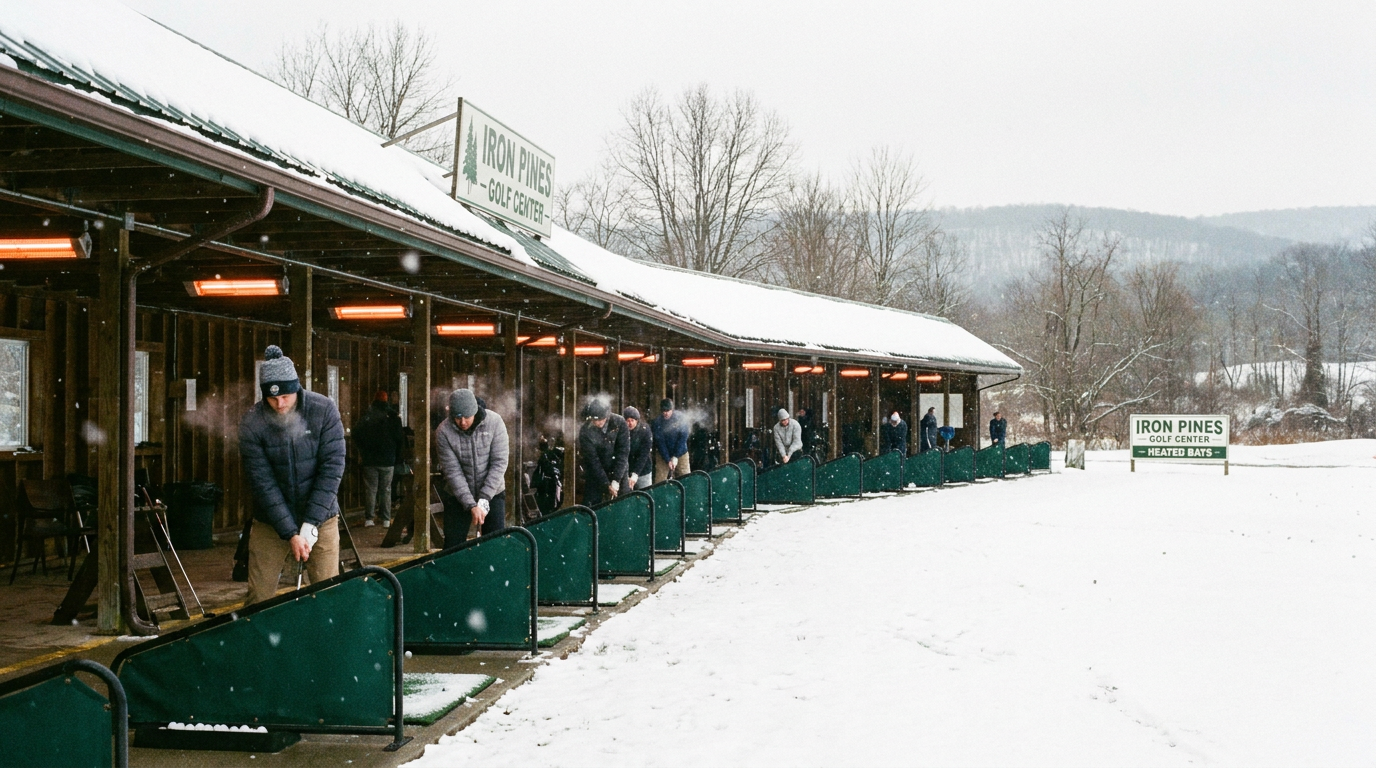
Covered and heated bays. We have roughly forty bays, with covered and heated options for the cold months. The practical effect is straightforward: cold muscles produce inconsistent swings and are more prone to injury, and nobody makes good changes while they’re shivering. Heated bays mean you can take an unhurried hour in January and actually work, rather than hitting twelve rushed shots and retreating to the car. That’s the entire off-season unlocked.
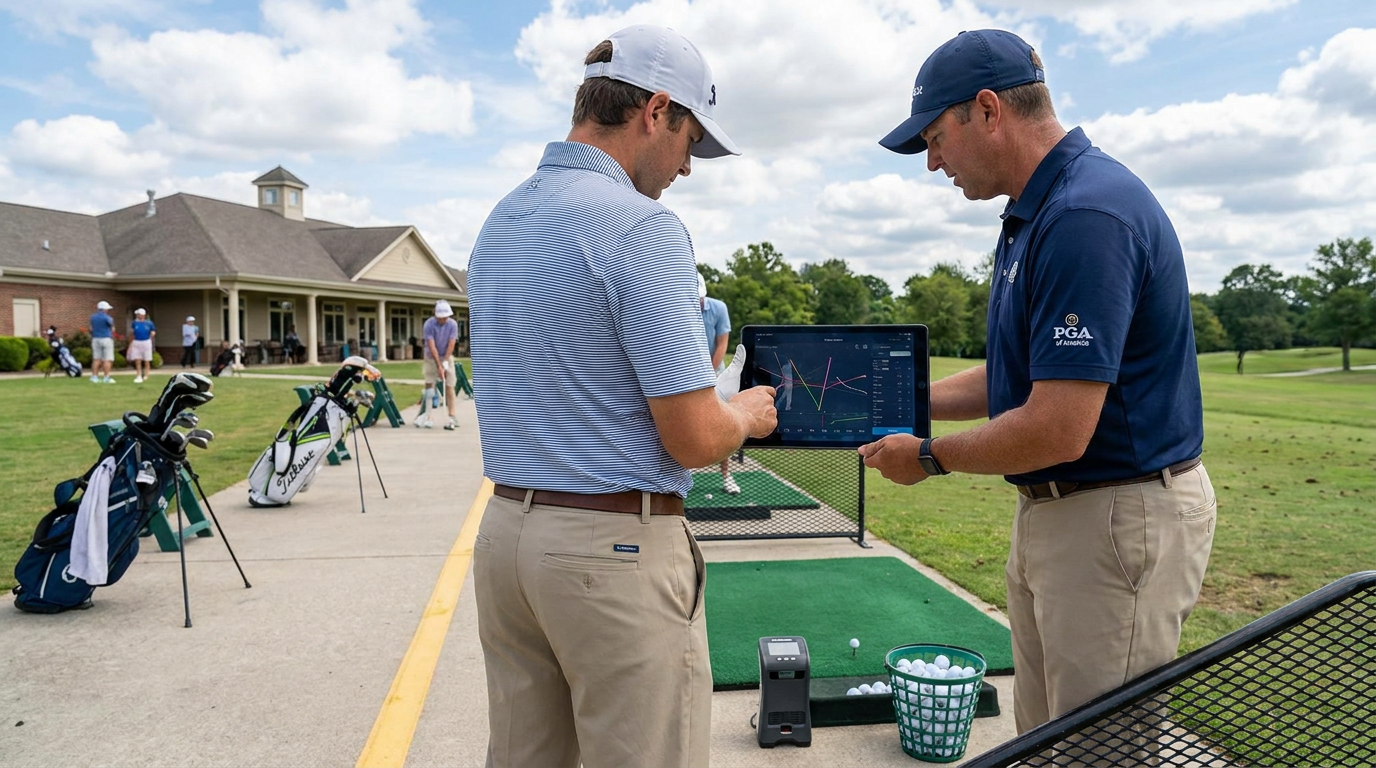
Toptracer-equipped range bays. Toptracer uses camera-based tracking to show you what the ball actually did — carry distance, total distance, ball speed, launch angle, apex height, hang time, landing angle, and how far offline the shot finished. Why this matters: almost every amateur golfer I’ve ever met is wrong about how far they hit the ball. Not slightly wrong. Systematically, confidently wrong, usually by a full club and a half, because they remember their best-ever 7-iron and have quietly adopted it as their normal one. Toptracer replaces that fiction with a number. Knowing your real carry distances is one of the fastest scoring improvements available to a mid-handicapper, and it requires no swing change whatsoever.
Uneekor Eye XO indoor simulators. The Eye XO uses dual high-speed overhead cameras that read the dimple pattern on a normal golf ball, so there’s nothing to mark or set up. Beyond ball data, it captures what the club is doing at impact — club head speed, attack angle, club path, face angle, dynamic loft, where on the face you struck it, and smash factor.
That club path and face angle pairing deserves a moment, because it’s the actual physics behind the most common complaint in golf. A slice isn’t caused by “coming over the top” in some vague sense — it’s caused by a specific relationship between the direction the club is travelling and where the face is pointed at impact. When you can see those two numbers, a slice stops being a mysterious curse and becomes a measurable relationship you can adjust. I’ve watched golfers who’d fought a slice for fifteen years understand it in about four minutes once the numbers were on a screen in front of them.
Simulators also solve the sunset problem. It’s dark at 4:30 in December. You can still play eighteen holes indoors, work on wedge distances, and keep your hands on a club during the months when your golf would otherwise be entirely theoretical.
Slow-motion video analysis. This is the one I’d choose if I could only keep one. The single largest obstacle in golf instruction is the gap between what a golfer feels and what a golfer does. It is enormous, it is universal, and it is invisible without a camera. A student will tell me with total sincerity that they made an enormous change, and the video will show a difference of about two degrees. Conversely, a change that feels violent and extreme is often exactly right. Video instruction and swing analysis closes that gap faster than any amount of verbal description, because you stop arguing about what happened and simply look at it.
Practice bunker and grass tees. Unglamorous and important. Most amateurs have never practiced a bunker shot in a low-stakes setting, which is why the shot terrifies them. And grass tees tell you the truth about your strike in a way mats never will, because a mat forgives a fat shot and turf does not.
A Year-Round Plan for a Bucks County Golfer
Here’s a practical framework you can run regardless of where you practice. Steal it freely.
November through February — the off-season. Work on: swing changes, mechanics, mobility, building genuinely new patterns. Where: heated bays and indoor simulators. Success looks like: a new motion that feels almost normal by March. Not perfect. Normal.
March through April — the ramp-up. Work on: turning those changes into repeatable contact, and dialing in wedge distances. Where: heated bays, grass tees as weather allows, the practice bunker. Success looks like: reliable contact before your first real round, so April isn’t spent recovering.
May through August — in-season. Work on: scoring, short game, course management, on-course decision-making. Where: the range, short-game areas, and the course itself. Success looks like: lower scores achieved without swing-tinkering. This is the season to use your swing, not rebuild it.
September through October — assessment. Work on: an honest review of the season and setting one priority for the winter. Where: a video analysis session. Success looks like: one clear, specific goal to attack in the off-season. One. Not five.
Follow that for two consecutive years and you will not be the golfer who shoots the same score for six years. You’ll be a different player, because you’ll have had twenty-four months of continuous development instead of eleven months of golf spread across two calendars.
Knowing when to work, though, is only half the equation. The other half is knowing what kind of help you actually need — and that’s where most golfers guess.
Do You Need One Lesson, a Swing Rebuild, or a Season-Long Plan?
Most golfers book the wrong amount of instruction. I’d put it at the majority, comfortably.
It cuts both ways. Some golfers take a single lesson expecting a transformation, then conclude that lessons don’t work when they shoot 94 the following Saturday. Others sign up for an extensive rebuild when one honest conversation about their grip would have solved the entire problem in forty-five minutes.
Neither of those people got bad instruction. They got the wrong dose. So before you book anything with anyone, here’s a genuine self-diagnostic. Read it honestly and you’ll walk into your first lesson knowing what you’re asking for.
- You probably need a single lesson if something specific and recent has gone wrong. A slice that showed up three weeks ago. A shank that appeared out of nowhere last month. Trouble with one club while everything else feels fine. One clear problem, one identifiable cause, genuinely fixable in a session. If your golf was fine in June and fell apart in July, something specific changed — and specific changes have specific fixes. Don’t buy a package. Buy an hour.
- You probably need a short series of three to six lessons if you’ve plateaued at roughly the same score for a couple of seasons, or if your miss is genuinely unpredictable round to round. Plateaus are almost never caused by one thing. They’re usually two or three small compensations that have settled into a stable, mediocre equilibrium. Untangling that takes a few sessions with practice in between — the practice between lessons is where the actual change happens.
- You probably need a swing rebuild if your fundamentals are working against you. Grip, setup, pivot — the things that happen before the club ever moves, or that shape everything downstream. You’ve been compensating for years, and every fix you try creates a new problem somewhere else. That last symptom is the diagnostic one. When correcting your slice produces a hook, and correcting the hook produces a fat shot, you’re not fixing a swing flaw — you’re moving a compensation around a system that was built crooked. Now let me be straight with you about what that involves: a rebuild will make you worse before it makes you better. Months, not weeks. There will be a stretch where you genuinely cannot score and you’ll wonder what you’ve done. Any coach who doesn’t tell you that before you start isn’t being honest with you. Start it in November, never in June.
- You probably need a season-long plan if you have a real goal with a date attached. A club championship in August. A handicap target. A golf trip you’ve been invited on. A junior trying to make a high school team. Dated goals need reverse-engineering — work backward from the date, decide what has to be true at each stage, and sequence accordingly. This is exactly what monthly programs and lesson packages are built for, because a goal nine months out needs continuity rather than a handful of disconnected appointments. If your goal is a specific handicap number, the USGA’s handicap and GHIN information is where to start — you can’t improve a number you aren’t tracking.
- You probably need a playing lesson or on-course work if you strike it beautifully on the range and fall apart on the first tee. I cannot stress this enough: that is not a mechanics problem. Your swing is fine. You have a decision-making and pressure problem, and no amount of range work will touch it, because the range is precisely the environment where your problem doesn’t exist. You need someone walking alongside you while you choose clubs, manage nerves, and decide whether to take on that pin. Different problem, different setting, different cure.
The Uncomfortable Conversation Worth Having
I’ll add something here that isn’t in my commercial interest, because I think it matters more than the booking.
Improvement in golf is cumulative, not transactional. You are not purchasing a fix. You’re purchasing a process, and processes have durations. That’s genuinely why monthly programs and packages exist — not as an upsell mechanism, but because the structure matches how skill acquisition actually works in a physical discipline.
But — and this is the part I want you to hear — that does not mean everyone needs one. If you’re in category one on that list, buy the single lesson. Fix the thing. Go play. I would rather send you home after forty-five minutes with a solved problem and your wallet mostly intact than sell you six sessions you didn’t need. That’s not generosity. It’s just how you build a teaching practice that still exists in ten years.
The corollary is equally true: if you’re in category three and you book a single lesson, I’m going to tell you honestly that one session won’t do it. You’ll leave understanding your swing better, but you won’t leave fixed, and I’d rather you know that going in than feel shortchanged going out.
So that’s how much instruction you need. The next question is what kind — and who it’s for.
Matching the Right Lesson Format to the Right Golfer
Format matters as much as content. The identical instruction, delivered by the identical coach, succeeds or fails depending on whether the setting fits the person receiving it.
I’ve watched a nervous beginner shut down completely in a one-on-one session — too much attention, too much scrutiny, too much silence between shots — and then blossom in a group clinic where she could watch three other people hit it sideways first. I’ve watched a serious single-digit player waste a group lesson because he needed forty-five uninterrupted minutes on one specific move and instead got twelve minutes and some general advice.
Neither of those is an instruction failure. Both are format failures. So let’s take them one at a time.
Private Lessons
Available in 30, 45, and 60-minute formats. Maximum focus, zero wasted time, everything oriented around your swing and nothing else.
The thirty-minute private lesson deserves a specific mention, because I think it’s the most underused option in golf instruction. If you’re unsure about any of this — unsure whether lessons work, unsure whether you want to commit, unsure whether you’ll feel foolish — thirty minutes is a genuinely low-commitment way to find out. It’s enough time to diagnose one clear problem and give you something concrete to work on. It is not a big decision, and I’d encourage anyone hesitating to treat it as the small thing it is.
Sixty minutes is the right call when you’re doing mechanical work, when video is involved, or when the problem is layered enough that you need time to work through cause and effect rather than symptoms.
Junior Golf in Bucks County
This one matters enormously around here, and I want to speak directly to the parents reading — in Doylestown, in Warrington, in Jamison, in Chalfont.
If your child has started asking to come along, or picked up a cut-down club at a family barbecue and swung it with unexpected enthusiasm, you’re at a genuinely important moment. What happens in the next few months largely determines whether golf becomes something they love for fifty years or something they tried once.
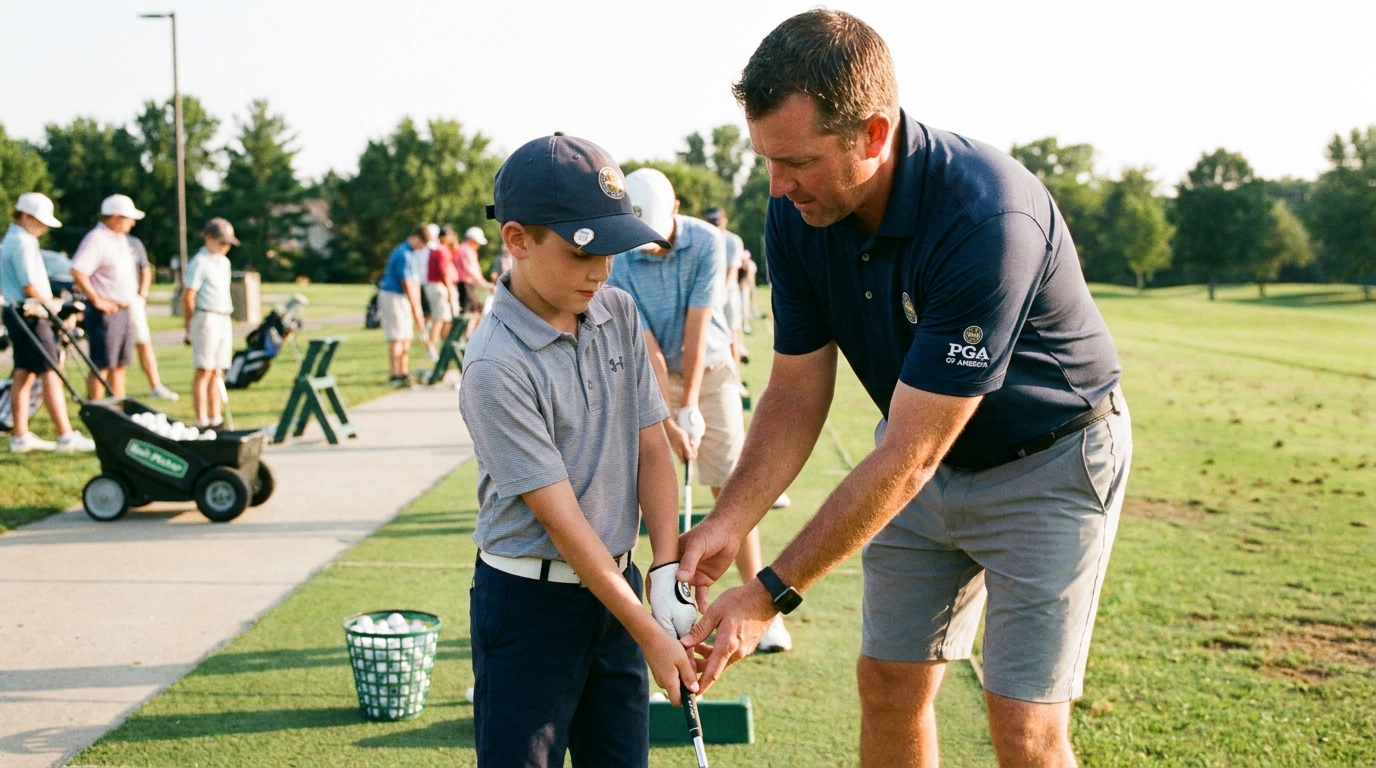
So here’s my philosophy on junior golf, stated as plainly as I can: fundamentals and fun, in that order, before competition ever enters the conversation. Grip, posture, balance, and a safe, athletic motion. Those things are worth getting right early because they’re difficult to unwind later. But they get taught inside a session that a nine-year-old actually wants to attend — with games, targets, small competitions against themselves, and considerably more laughing than a typical adult lesson contains.
“With kids, the first job isn’t the golf swing. It’s making sure they want to come back next week.”
I coach with First Tee of Greater Philadelphia, and I’d point any parent toward their work whether or not you ever bring a child to me. First Tee’s whole model is built around using golf to develop character and life skills rather than manufacturing junior competitors, and that framing is exactly right. Most kids who start golf will not play college golf. Nearly all of them can have a game they enjoy for the rest of their lives, and that second outcome is worth far more than the first.
Women’s Lessons and Ladies’ Clinics
I want to name something directly, because pretending otherwise helps nobody: golf has historically not been especially welcoming to women beginners, and a lot of women arrive at a first lesson braced for condescension.
Ladies’ clinics exist as a lower-pressure entry point — a supportive setting, a shared pace, and the significant relief of not being the only person present who’s never done this before. There’s something genuinely freeing about a room where everyone is equally new. Questions get asked that wouldn’t get asked one-on-one, and the collective permission to be a beginner accelerates learning more than people expect.
Private lessons work just as well for women golfers who’d prefer them, of course. The point isn’t that one format is correct — it’s that if intimidation is the thing standing between you and starting, the clinic format is specifically designed to remove it.
Family Sessions
An underrated option. Rather than everyone learning separately and then failing to communicate about it on the course, the whole family learns the same vocabulary at the same time.
The practical benefit is real. When a parent and a twelve-year-old have both heard the same explanation of what the clubface does, the car ride home becomes a conversation rather than contradictory coaching. And golf is one of the genuinely small number of activities a family can do together across a forty-year age gap. That’s worth protecting.
Group Lessons
Social, more affordable per person, and excellent for beginners. Three or four friends learning together removes the spotlight entirely, and people learn a surprising amount from watching someone else receive a correction. The trade-off is straightforward: less individual attention. If you need precision work on a specific move, this isn’t your format.
Video Instruction and Swing Analysis
For the feel-versus-reality gap I described earlier. Slow-motion capture shows what you actually do rather than what you believe you do, and it’s the fastest route to understanding for the many golfers who are visual learners and have been trying to learn golf through verbal description alone.
Which Format Fits You?
A quick sorting guide:
- One specific problem to solve → Private lesson, 30 or 45 minutes. Focused, fast, no wasted time.
- Rebuilding mechanics → Private lessons plus video analysis, 60 minutes. You need to see the change, not merely feel it.
- A child new to golf → Junior instruction, 30 to 45 minutes. Fundamentals and fun before competition.
- New to golf and prefer low pressure → Women’s lesson or ladies’ clinic, 45 to 60 minutes. Supportive setting, shared pace.
- A family that wants to play together → Family session, 60 minutes. Everyone learns the same language.
- Friends learning together → Group lesson, 60 minutes. Social, affordable, ideal for beginners.
- Range hero, course disaster → Video instruction or on-course work, 45 to 60 minutes. Slow-motion shows what you actually do.
If you’d like to see how the lesson formats and rates are structured before deciding, that’s all laid out — and I’d genuinely rather you arrive having chosen a format deliberately than default into whatever was listed first.
Having covered what and how, let’s return to the question I suspect you’ve been holding since the third paragraph. Is the drive actually worth it?
What the Drive from Bucks County Actually Buys You
Fair question. Let me answer it directly rather than circling.
About twenty minutes in the car, give or take traffic. What does that purchase?
The Facility
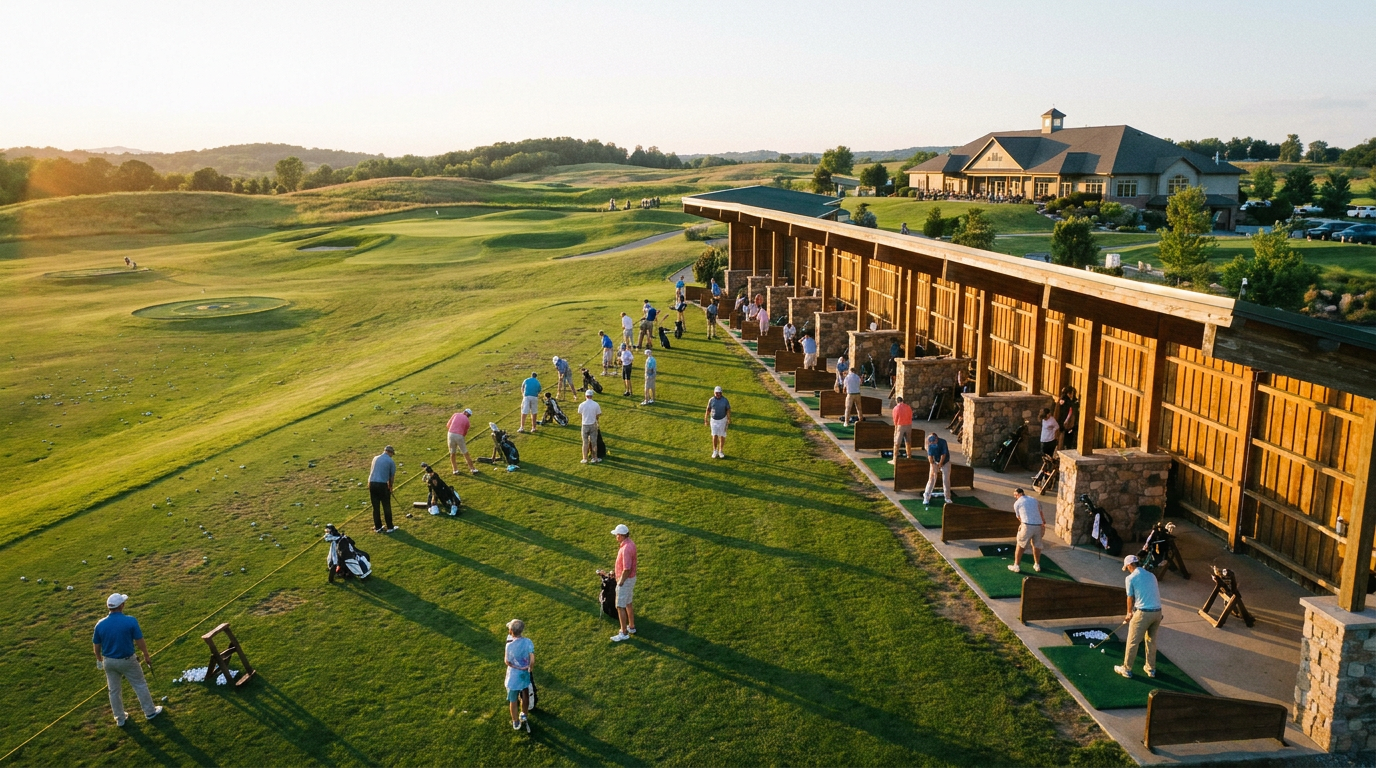
Roughly forty bays. Grass tees. Covered and heated bays for the cold months. A practice bunker. Toptracer-equipped range bays. Uneekor Eye XO indoor simulators. Slow-motion video analysis. All in one place, all twelve months of the year.
I’ve listed the equipment, but I want to be clear that the equipment isn’t the point. Any of those things can be found somewhere. The point is the word and — that they exist together, in one location, continuously, so that you never have to stop working.
Progress in golf isn’t produced by peak effort. It’s produced by the absence of interruption. The golfer who practices moderately for twelve months will beat the golfer who practices intensely for seven, every time, because the second golfer spends six weeks of every spring rebuilding what winter dismantled. Continuity is the entire mechanism, and continuity in Pennsylvania requires a roof and a heater.
The Credentials
I’ll state these once and let them sit, because credentials recited at length start to sound like insecurity.
PGA of America Member since 1997. More than twenty years teaching and playing. Recipient of the Philadelphia PGA Section Players Development Award in 2012. Coach with First Tee of Greater Philadelphia. And a verified PGA.com coach profile if you’d like third-party confirmation of any of it.
What PGA Membership Actually Means
Here’s something worth knowing regardless of who you eventually work with, because most golfers genuinely have no idea what the letters signify — and I think that’s a shame, since the information is useful when you’re evaluating anyone.
Becoming a PGA of America Member is not a weekend certification. The pathway runs through the PGA Professional Golf Management program, and it requires passing the Playing Ability Test — an on-course examination demonstrating you can actually play the game to a standard — along with a background check and full-time employment in the golf industry. From there it’s a structured curriculum across multiple levels, with seminars, examinations, and documented work-experience portfolios at each stage. Associates specialize along a career path; for teaching professionals, that means coursework in how people actually learn motor skills, swing analysis, teaching program design, communication methods, junior development, and club fitting.
It takes years. Candidates have up to nine of them to complete the requirements. The PGA of America publishes its own explanation of what becoming a PGA Professional involves if you want the detail from the source.
Why does this matter to you? Because it means a PGA Member has been formally trained in how people learn, not merely in what a golf swing looks like. Those are radically different competencies. Plenty of people can identify a swing fault. Far fewer have been taught how to communicate a correction in a way that a specific human being can absorb, retain, and reproduce under pressure. The second skill is the one you’re actually paying for.
If You’re Still Evaluating Instructors
If your bigger question isn’t really about Bucks County at all — if it’s “how do I tell a good golf instructor from a mediocre one, anywhere?” — that’s a fair and separate question, and I’ve written a companion guide on exactly that: what to look for, what to ask, and what should give you pause. You’ll find it, along with everything else I write, among the articles on the Insights blog.
I’d encourage you to read it before booking with anyone, including me. A golfer who knows what to look for is a better student, asks sharper questions, and gets more out of every session. That’s a good outcome no matter whose lesson tee they end up standing on.
The Trade, Not the Sacrifice
“Twenty minutes in the car buys you twelve months of practice instead of seven. That’s the whole trade.”
I want to frame the drive accurately, because I don’t think it’s a sacrifice and I don’t want to argue that it is one nobly borne.
It’s a trade. A few extra minutes in the car, in exchange for a place where your progress doesn’t stop in November. Whether that trade is worth it depends entirely on how much you want to shoot a different number than you shot last year. For plenty of golfers the honest answer is “not that much” — they love their Saturday game exactly as it is, and there is genuinely nothing wrong with that. Golf doesn’t owe anyone improvement.
But if you’ve been quietly frustrated for a few seasons, if you’ve thought more than once that you’re better than your scorecard suggests, then twenty minutes is a remarkably small price for the thing that actually changes it.
Let me close out with the questions I get asked most often before someone books.
Common Questions from Bucks County Golfers
Do you teach golfers from Doylestown?
Yes — regularly, and a good number of them. Doylestown is roughly a twenty-minute drive from the academy, straight down through Chalfont, and it’s one of the most common hometowns I see on my lesson schedule. Central Bucks golfers make this trip constantly, often on the way home from work. If you’re in Doylestown and wondering whether you’d be an outlier driving over the county line for lessons, you’d be in fairly crowded company.
How far is the academy from central Bucks County?
We’re at Lower State Road Golf Center, 500 Lower State Rd, North Wales, PA 19454 — right on the Montgomery/Bucks line. Rough approximations: Chalfont and Horsham around 15 minutes; New Britain 15 to 20; Doylestown and Warrington around 20; Furlong, Jamison and Warminster 20 to 25; Buckingham around 25. Traffic moves all of those, so check your own route. The short version is that most of central Bucks is inside a half-hour.
Do you offer junior golf lessons for Bucks County families?
Yes. Junior instruction is a significant part of what I do, and I also coach with First Tee of Greater Philadelphia. Sessions typically run 30 to 45 minutes depending on age and attention span. The philosophy is fundamentals and fun before competition — grip, posture, balance and a safe athletic motion, taught inside a session a child actually enjoys. Most kids can start meaningfully around ages six to eight, though it depends far more on the individual child’s interest than on their birthday.
Can I take golf lessons in the winter in Pennsylvania?
Yes — and I’d argue it’s the best time of year for it. We have covered and heated bays plus Uneekor Eye XO indoor simulators, so weather and early sunsets stop being obstacles. More importantly, winter is when swing changes actually take hold, because there’s no scorecard and no pressure to perform while you’re learning something new. If you’re planning to change something significant about your golf swing, starting it in January is dramatically smarter than starting it in June.
Do I need my own clubs to start?
No. Plenty of people take a first lesson without owning a single club, and it’s a completely normal way to begin. I’d honestly prefer beginners don’t buy a set before their first lesson — it’s much better to learn a little about your swing first, then buy clubs that suit you, rather than guessing in a shop and living with the consequences for a decade. Come as you are and we’ll sort out equipment when it’s actually relevant.
How long is a typical golf lesson, and how many will I need?
Lessons run 30, 45, or 60 minutes. Thirty is ideal for one specific problem; sixty suits mechanical work and video analysis. As for how many — that depends entirely on which category you fell into in the self-diagnostic earlier in this article. One recent, specific problem is often a single session. A multi-season plateau usually needs three to six. A genuine rebuild takes months. If you’re unsure which describes you, the fastest route to an answer is simply asking: contact the academy, call 267-240-0629, or email dcsjr@pga.com and describe what’s happening. I’ll tell you honestly what I think you need, including when that’s less than you expected.
Do you teach women’s lessons and group clinics?
Yes — ladies’ clinics, group lessons for friends learning together, and family sessions where everyone learns at once. All three exist primarily to lower the intimidation barrier, which is the single most common thing keeping new golfers off a lesson tee. You can see how the various formats are structured on the page covering lesson rates and monthly programs.
If your question isn’t here, the fastest way to an answer is a phone call. I’d rather spend three minutes telling you what you need than have you guess.

The Real Reason Your Scores Haven’t Moved
Let’s go back to the golfer from the beginning. Thirty rounds a summer, six years, the same score.
Nothing about him is broken. He’s not untalented, not lazy, not too old, not any of the explanations golfers quietly offer themselves around the ninth hole. He’s simply been doing the one activity — playing — that reliably maintains a skill without ever developing it, during the seven months a year the weather permits it, and then stopping cold for five.
What changes that is unglamorous and entirely achievable. Structure, so that practice has a purpose beyond emptying a bucket. Honest feedback, so that the gap between what you feel and what you do stops being invisible. And a place to work in every month of the year, so that November stops undoing what October built.
That’s the whole argument. The best golf lessons for Bucks County, PA golfers may well be a short drive over the county line — and what that drive actually buys isn’t fancier equipment. It’s a full calendar instead of a seven-month one.
And I meant what I said at the start. If you take the seasonal plan and the self-diagnostic from this article, apply them with a coach five minutes from your house, and never once think about DCSJr Golf Academy again, then this did exactly what I hoped. Good information should be useful independent of who wrote it.
But if you’ve read this far, there’s a decent chance you’ve been meaning to sort this out for a while. A couple of seasons, maybe six years. The season’s winding down, which — as I hope I’ve convinced you — makes right now close to the ideal moment to start.
The first step is smaller than you think. It’s a half hour on a lesson tee and a conversation about what’s actually going on with your golf swing.
Ready to Get Started?
Book a lesson. The simplest way forward. Get in touch and we’ll find a time — or just call 267-240-0629 or email dcsjr@pga.com and tell me what’s going on with your game. A thirty-minute session is a perfectly good place to begin.
See rates and programs. If you’d rather understand pricing and structure before committing, view lesson rates and monthly program options at your own pace.
Not ready yet? That’s fine. Join the newsletter for seasonal advice and practice tips throughout the year. No obligation, and no expectation that you ever book anything.
DCSJr Golf Academy at Lower State Road Golf Center
500 Lower State Rd, North Wales, PA 19454
Serving golfers from Doylestown, Warrington, Chalfont, New Britain, Buckingham, Warminster, Jamison, Furlong, and Horsham.
David C. Smith Jr., PGA Professional