
I’ve been teaching golf in Montgomery County for more than 25 years. In that time, standing on the tee line at Lower State Road Golf Center in North Wales, I’ve watched thousands of golfers walk onto my lesson tee — beginners gripping a club like a baseball bat, juniors with more raw talent than they knew what to do with, retirees rediscovering the game, and single-digit players chasing one more stroke. And I’ve noticed something that has almost nothing to do with talent: the golfers who improve the most aren’t necessarily the ones with the most athletic ability or the most free time. They’re the ones who chose the right instructor.
Here’s the uncomfortable truth about our industry. Most golfers pick an instructor blindly. They book with whoever answered the phone first, whoever a buddy mentioned once, or whoever had an opening on Saturday. Sometimes that works out. But too often it doesn’t — and the cost isn’t just money. The wrong instructor can bake bad habits so deep into your swing that undoing them takes twice as long as building it right would have. A good instructor saves you years of frustration. A bad fit can genuinely make you worse.
Golfers looking for golf lessons in Montgomery County, PA have more options than ever — driving ranges, indoor simulator studios, country club pros, independent coaches, and everything in between. That abundance is a blessing, but only if you know how to evaluate what you’re looking at. Most people don’t, because nobody’s ever told them what to look for. That’s what this article is for.
Over the next few thousand words, I’m going to walk you through everything I’d tell a friend who asked me, “How do I find a good golf instructor around here?” We’ll cover what credentials actually mean (and which ones are just letters), how to judge a teaching philosophy before you’ve paid for a single lesson, why the technology and facility your instructor uses matter more than most golfers realize, how to match lesson programs to your actual goals and budget, and — because I want this to be genuinely useful — a practical checklist of seven questions to ask any instructor before you book. But before we get to choosing an instructor, it helps to appreciate just how rich the golf scene here really is, because the local landscape shapes everything else.
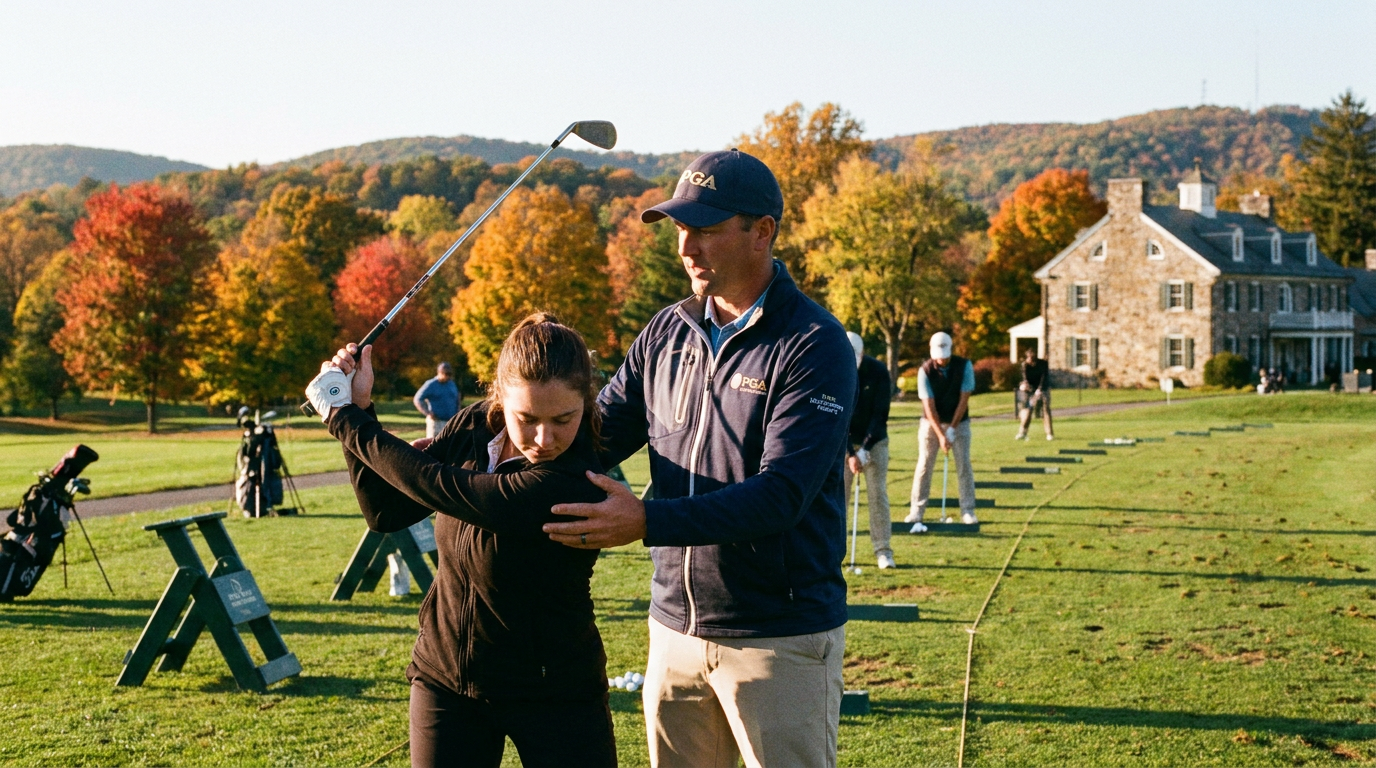
Why Montgomery County Is One of the Best Places in Pennsylvania to Learn Golf
If you’re going to learn golf anywhere in Pennsylvania, you picked a good county to do it in. Montgomery County — Montco, to the locals — isn’t just a place that happens to have some golf courses. It’s a genuine golf destination, and the numbers back that up. The county is home to more than 50 public and private golf courses, one of the largest concentrations of golf anywhere in the region. The local tourism board doesn’t even try to be modest about it — Montco’s 50+ public and private golf courses are marketed under the tagline “300,000 yards. 1 destination.” That’s not hype. Add up the yardage of every course in the county and you genuinely get more than 300,000 yards of golf.
What does that mean for you as a learner? Two things, and they’re both important.
First, it means you’ll never run out of places to take your improving game. Montco isn’t a county where you learn to play and then drive an hour to find a tee time. There are more than 20 public golf courses across Montgomery County alone, spanning every price point from budget-friendly nine-holers to championship layouts that have hosted professional events. Whether you’re playing your first full round or your five-hundredth, there’s a course within twenty minutes that fits your game and your wallet. I tell my students all the time: the whole point of lessons is what happens after the lesson, and in Montco, what happens after the lesson can happen almost anywhere.
Second — and this is the part most golfers miss — an abundance of courses makes quality instruction the real differentiator. When everyone has access to the same fairways, the same practice greens, the same tee times, the thing that separates the golfer who improves from the golfer who plateaus isn’t access. It’s guidance. I’ve seen twenty-year members of beautiful local courses who shoot the same score today they shot in 2010, and I’ve seen golfers who found the right coaching drop ten strokes in two seasons playing the exact same courses. The courses are the classroom. The instruction is the curriculum.
“Montco has more than 50 courses. What it needs more of is golfers who know how to play them.” — David C. Smith Jr.
There’s another thing about Montgomery County golf that people who didn’t grow up here don’t always appreciate: this is a year-round golf culture, even though it’s Pennsylvania. Yes, our winters are real. But the county has built an infrastructure that refuses to let the season end — heated driving range bays, indoor simulators, covered hitting areas, and practice centers that stay busy in January. The golfers around here who make big jumps in their games are very often the ones who treat November through March as their improvement season rather than their hibernation season. More on that later, because it’s one of my favorite subjects.
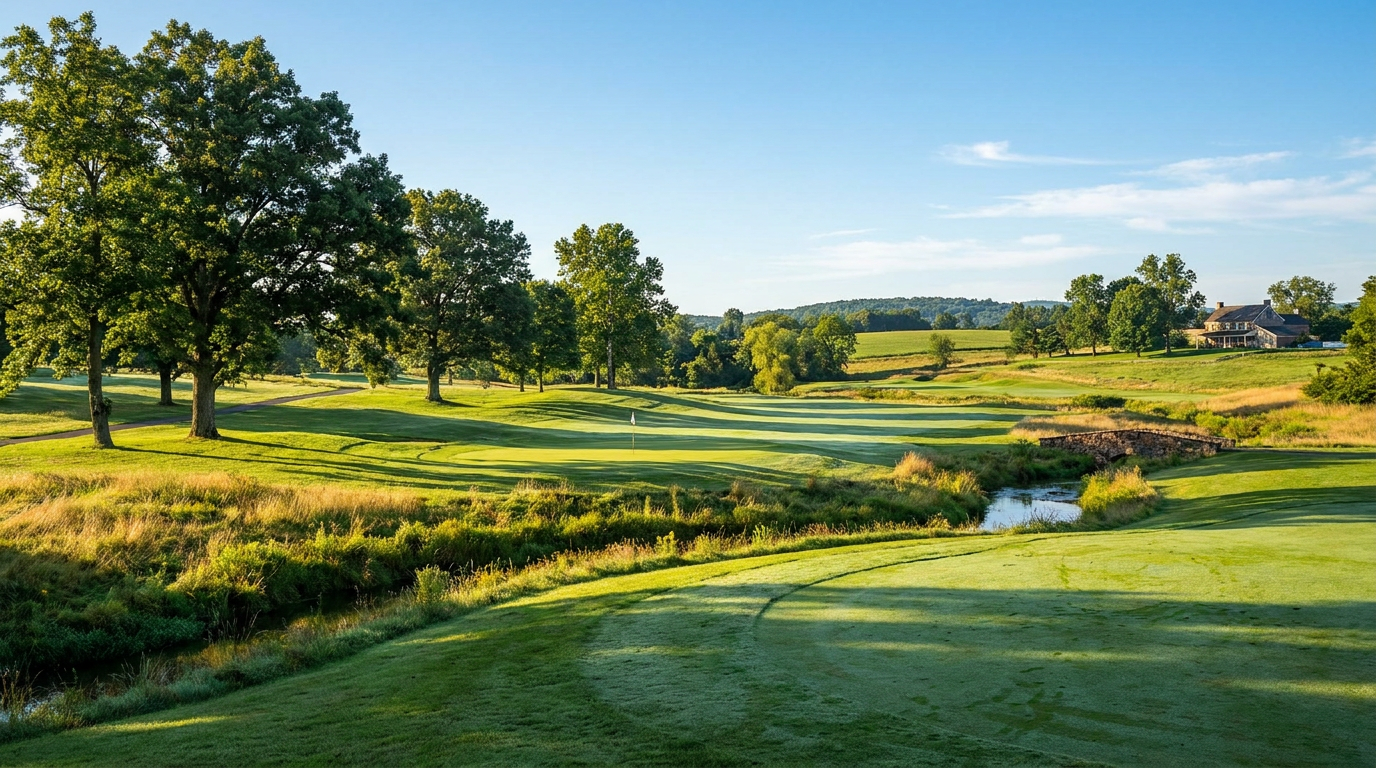
Let me anchor all of this somewhere specific, because “Montgomery County” covers a lot of ground. My academy — DCSJr Golf Academy — operates out of Lower State Road Golf Center at 500 Lower State Rd, North Wales, PA 19454. If you know the area, you know how central that is: we’re minutes from Lansdale, Montgomeryville, Blue Bell, Ambler, and an easy drive from Doylestown just over the Bucks County line. For golfers searching for North Wales, PA golf practice and instruction, Lower State Road Golf Center has been a fixture for a long time — a family-owned facility that’s been serving this community since the early 1990s. It’s not a flashy corporate operation. It’s the kind of place where the person behind the counter knows your name by your third visit, and where I’ve watched juniors I taught in elementary school come back years later with their own kids.
I mention the specifics not to sell you on my range, but because location genuinely matters when you’re choosing instruction. Improvement requires repetition, and repetition requires convenience. The best instructor in the world doesn’t help you much if the drive is long enough that you skip half your practice sessions. When you’re evaluating your options, draw a realistic circle around your home or office and take seriously the facilities inside it.
So here’s the key insight I want you to carry out of this section: courses are everywhere in Montco. What’s rare — what actually separates golfers who improve from golfers who stay stuck — is great golf instruction in Montgomery County. The rest of this article is about how to find it. And the first filter, the non-negotiable one, is credentials.
What “PGA Professional” Actually Means (and Why Credentials Matter)
Here’s something that surprises a lot of golfers: there is no legal requirement to have any qualification whatsoever to teach golf. None. Anyone can rent a bay at a driving range, print business cards that say “Golf Coach,” and start charging you $90 an hour. Some of those self-taught teachers are decent. Some are enthusiastic 5-handicaps repeating tips they heard on YouTube. From the outside, you often can’t tell the difference — which is exactly why credentials exist, and exactly why they should be your first filter when searching for a PGA golf instructor in North Wales, PA or anywhere else in Montgomery County.
So let me explain what “PGA Professional” actually means, because it’s a title that gets used loosely and deserves better.
Becoming a PGA of America Member is not a weekend certification. It’s a multi-year professional program — closer in structure to a trade credential or a professional license than to an online course. The PGA of America membership pathway requires candidates to pass a Playing Ability Test (you have to prove you can actually play the game to a defined standard, under pressure, with a scorecard that counts), complete extensive coursework covering teaching methodology, swing mechanics, club fitting, rules, and the business of golf, and work through supervised, documented experience in the industry. If you’re curious about the full journey, the PGA publishes a plain-English breakdown of how someone becomes a PGA of America Golf Professional — it’s worth two minutes of your time before you book with anyone.
The contrast matters. A PGA Member has been tested on playing ability, trained in how people actually learn, educated on equipment and fitting, and held to a professional code — and then required to keep learning through continuing education for as long as they hold the credential. A self-described “golf coach” may have done none of that. When you hire a PGA Professional, you’re not paying for the letters. You’re paying for the years behind them.
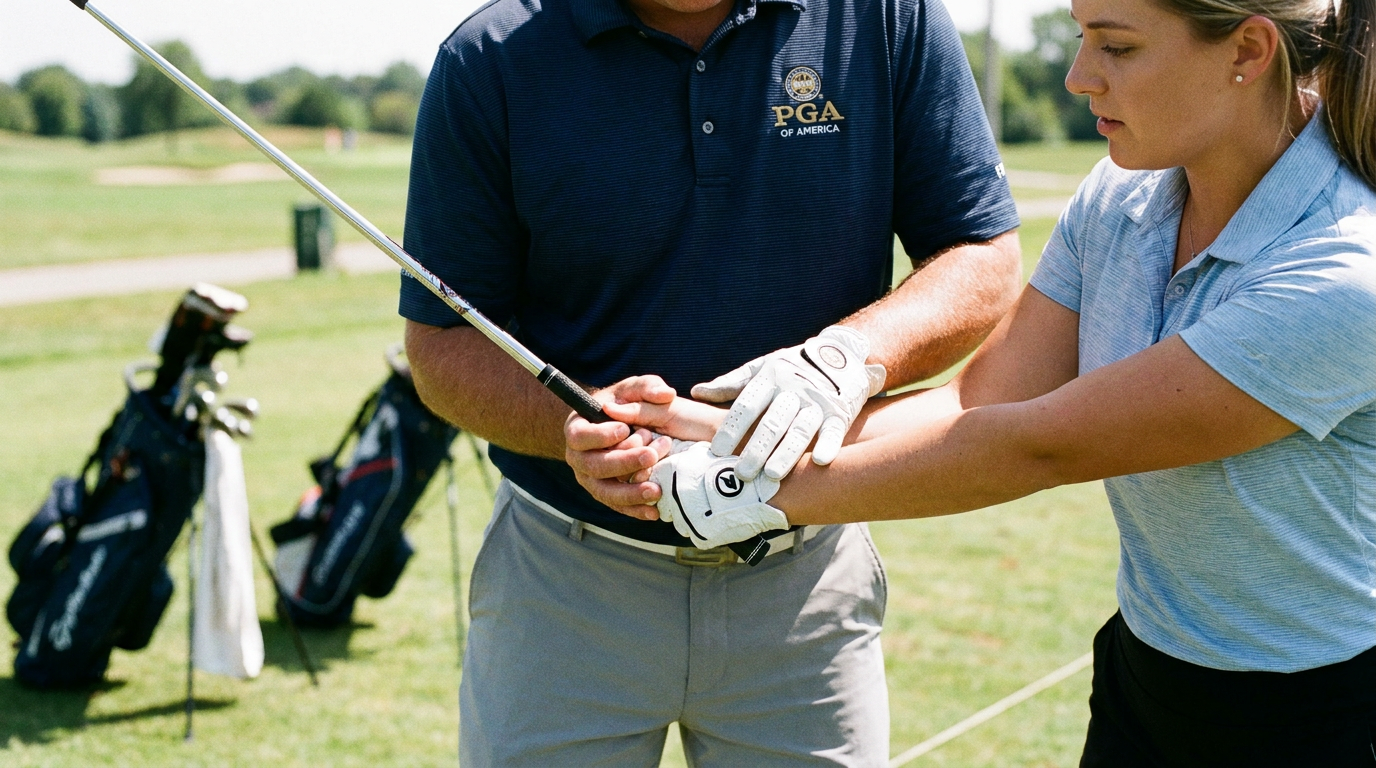
Since I’m asking you to check credentials, it’s only fair I put mine on the table. I’ve been a PGA of America Member since 1997 — coming up on three decades now. In 2012, the Philadelphia PGA Section honored me with its Players Development Award, which recognizes professionals who grow the game by developing new and improving golfers, not just polishing the games of players who already have one. And for years I’ve coached with The First Tee of Greater Philadelphia, working with junior golfers on both their swings and the life skills the game teaches. I don’t list those things to impress you — I list them because they’re verifiable, and that’s the whole point. If you want to dig into my background before we ever speak, you can meet Dave and judge for yourself. Any instructor worth hiring should make that kind of verification easy.
Here’s why this consumer-protection framing matters more than golfers realize. Golf instruction is a trust purchase. You can’t evaluate the product before you buy it — by the time you know whether the lessons worked, you’ve already spent the money and, more importantly, the practice hours. Credentials are the closest thing you have to a quality guarantee before the fact. PGA membership is public. Section awards are public. A quick search tells you whether the person about to rebuild your swing has ever been vetted by anyone other than themselves.
A practical tip from someone on the other side of the lesson tee: ask any prospective instructor two simple questions — “How long have you been a PGA Member?” and “What continuing education have you completed recently?” A credentialed professional will answer both in ten seconds and probably enjoy the conversation. Someone who bristles at the question just told you everything you need to know.
One caveat, because I believe in giving you the full picture: credentials are a floor, not a ceiling. PGA membership tells you an instructor has been trained, tested, and vetted. It does not automatically tell you they’re the right teacher for you. I know brilliant PGA Professionals whose communication style would drive certain students crazy, and those same students might thrive with a different PGA Professional down the road. Credentials get an instructor onto your shortlist. They shouldn’t be the only thing that gets someone off it.
Which brings us to the harder, more interesting question — the one that actually determines whether your lessons work. Once you’ve confirmed an instructor is qualified, how do you figure out how they teach? That’s where philosophy comes in.
Teaching Philosophy: The Difference Between a Quick Fix and Lasting Improvement
If credentials are the first filter, teaching philosophy is the one that matters most. It’s also the one almost nobody asks about, because most golfers don’t know they’re allowed to.
Let me start with the biggest red flag in all of golf instruction, because if you learn nothing else from this section, learn this: beware the one-size-fits-all method teacher. You’ll recognize them quickly. They have a model swing — sometimes it’s a famous tour player’s, sometimes it’s a “system” with a trademarked name — and every student who walks through the door gets reshaped toward that model regardless of their body, their age, their flexibility, their athletic history, or their goals. A 62-year-old with a fused vertebra gets the same positions as a 16-year-old junior. A weekend player who wants to break 90 gets the same rebuild as someone chasing a college roster spot.
Method teaching survives because it’s easy to sell. It sounds confident. “This is the right way to swing, and I’ll teach it to you.” But bodies aren’t interchangeable, and neither are goals. Great instructors don’t teach a swing — they teach a student. They adapt the fundamentals to the person in front of them. Look at any professional tour and you’ll see wildly different-looking swings winning tournaments; what they share isn’t a shape, it’s a set of fundamentals expressed through each player’s body. That should tell you something about how the rest of us ought to learn.
So what’s my philosophy? I’d call it process-oriented, fundamentals-first, and built for the long game — what I like to call “golf for life.” Here’s what that means in practice. Improvement in golf is not a straight line from lesson to lower scores, no matter how much we’d all like it to be. It’s a cycle: you learn something new, you practice it until it stops feeling foreign, you test it under mild pressure, and eventually you perform it on the course when it counts. Then the cycle starts again at the next layer. Golfers who understand this cycle stay patient and keep improving for years. Golfers who expect every lesson to immediately produce a career round get frustrated and quit — usually right before the breakthrough. I wrote about this distinction in depth in Performance vs. Learning in Golf Practice, and if you take lessons anywhere, with anyone, understanding that difference will make every dollar you spend go further.
“My job isn’t to give you my swing. It’s to help you build the best version of yours.” — David C. Smith Jr.
Now, how do you evaluate an instructor’s philosophy before committing? You watch how they communicate, starting with the very first conversation. Here’s what good communication looks like in a golf lesson, based on almost three decades of giving them:
- The instructor asks about your goals before touching your swing. If someone starts rebuilding your grip ninety seconds into your first lesson without asking what you’re trying to accomplish, how often you play, or what your golf history looks like, that’s a teacher running a script — not coaching a person.
- They explain cause and effect, not just tips. There’s a world of difference between “strengthen your grip” and “your ball curves right because the clubface is open relative to your path at impact — here’s how your grip contributes to that, and here’s why this change will straighten the flight.” The first is a tip you’ll forget by Thursday. The second is understanding you’ll own forever.
- They give you one or two priorities per lesson — not ten. The human brain can’t consciously manage five swing thoughts at 90 miles per hour. Anybody who has ever stood over a ball with a checklist in their head knows exactly what I mean. An instructor who piles on corrections isn’t being thorough; they’re being undisciplined. Great teaching is as much about what the coach doesn’t say as what they do.
- They send you away with structured homework. This one is huge, and it’s the most commonly skipped. A quality instructor ends every lesson with a written or clearly structured practice plan: what to work on, what drills to use, how many balls, what “success” looks like before the next session. Lessons without guided practice rarely stick — the lesson plants the seed, but practice is where it grows. If your last instructor never gave you homework, that’s a big part of why the changes didn’t hold.

I want to give you one more tool, and it’s a self-check you can run after any first lesson with any instructor, including me. On the drive home, try to explain — out loud, in your own words — what you’re working on and why. Not the instructor’s words. Yours. “I’m working on shallowing the club in transition because my steep downswing is why I hit those big slices” — that’s a golfer who understood the lesson. If you can’t articulate it, the problem isn’t your intelligence; it’s the communication. And communication is the instructor’s job. A lesson you can’t explain is a lesson that hasn’t fully happened yet.
I write regularly about coaching philosophy, practice structure, and how golfers actually improve over at the DCSJr Golf Academy Insights blog — if this section resonated with you, there’s plenty more there in the same spirit.
Philosophy tells you how an instructor thinks. But in modern golf instruction, thinking is only half the equation — the tools and the facility your instructor teaches with can dramatically accelerate your progress, or quietly limit it. Let’s talk about technology.
Technology and Facilities: Why Where You Learn Matters as Much as Who Teaches You
Every experienced teacher knows this phrase, and every student eventually learns it the hard way: feel isn’t real.
Here’s what I mean. A golfer will tell me, with complete sincerity, that they’re swinging way out to the right — they can feel it. Then we look at the data and their club path is still four degrees left. Or a student swears they made a huge, exaggerated change to their backswing, and the video shows the club moved about an inch. This isn’t a character flaw; it’s neuroscience. Your body’s sense of its own movement is notoriously unreliable, especially during a motion as fast as a golf swing. What feels like a massive change usually isn’t. What feels normal is often the very flaw we’re trying to fix.
For most of golf history, instructors dealt with this gap using trained eyes and educated guesses. Good teachers were pretty accurate. But “pretty accurate” has been replaced by actually measured, and there’s no going back. Launch monitors and ball-flight tracking tell us precisely what the club and ball did — path, face angle, launch, spin, carry distance — on every single swing. Video shows students what their body actually did versus what they felt. The gap between feel and real, the gap that used to take months of trial and error to close, can now be closed in a single lesson.
So when you’re evaluating facilities for golf instruction in Montgomery County, here’s what to look for:
- Ball-flight tracking on the range — technology like Toptracer, which traces every shot you hit and reports carry distance, curve, height, and dispersion. It turns an ordinary bucket of balls into a data session, and it makes practice honest. You can’t tell yourself that drive “would have been fine” when the screen shows it 35 yards offline.
- Indoor simulators — a controlled, measurable environment where wind, temperature, and lie never vary. When you’re making a swing change, that consistency is gold: if the numbers change, it’s because you changed, not the conditions. And in Pennsylvania, simulators are the difference between a four-month season and a twelve-month one.
- Video swing analysis — slow-motion video, ideally reviewed side by side with the instructor, so you can see what you’re doing rather than just hear about it. For most students, one good video comparison is worth a thousand verbal descriptions.
Let me ground this locally, since this is an article about Montgomery County. At Lower State Road Golf Center in North Wales, I teach with all three. Our range has Toptracer-equipped bays, so my students see real data on every shot — during lessons and, just as importantly, during their practice sessions between lessons. Indoors, we run Uneekor Eye XO simulators, which give us tour-level launch and club data in a controlled setting year-round. And I use slow-motion video analysis in my coaching constantly, because showing a student their swing next to a model — or next to their own swing from three months ago — communicates more in thirty seconds than I could in thirty minutes of talking. If you want to see how the video side of my coaching works before you ever book, take a look at my golf video instruction and swing analysis page.

The facility itself matters too, beyond the gadgets. Lower State Road is a roughly 40-bay range with genuine grass tees (a rarity worth seeking out — mats are convenient, but grass tells you the truth about your contact), covered and heated bays for cold weather, and a practice bunker for short-game work. That combination means a lesson in February looks and feels almost exactly like a lesson in June — same coach, same data, same structured practice, just warmer toes.
And that year-round point deserves its own paragraph, because it might be the single biggest untapped advantage for Montgomery County golfers. Most local players surrender four or five months to winter every year. They put the clubs in the garage in November, pick them back up in April, and spend May relearning what they knew in October. Meanwhile, the golfers who improve fastest do the opposite: they use the off-season deliberately. Winter is actually the ideal time for a real swing change — no rounds to protect, no scorecards creating pressure to revert to old habits, just uninterrupted time to rebuild properly. It’s exactly why I run off-season programs like my “Winter Overhaul,” using the slow months to do the deep work that’s hard to do mid-season. When your buddies emerge in April shaking off rust, my winter students show up with a swing that’s four months better than the one they finished last season with.
Now, a caveat — and I include it because I’d rather earn your trust than oversell you. Technology is a tool, not a teacher. A launch monitor can tell you your club path is six degrees out-to-in; it cannot tell you why, which of five possible causes is yours, or what drill will fix it for your body. Data without interpretation is just numbers on a screen, and I’ve watched golfers standing alone in simulator bays drowning in numbers while their swings got worse. So when you’re vetting instructors, the right question isn’t “Do you have technology?” — nearly everyone has something now. The right question is “How do you use technology in lessons?“ Listen for an answer about teaching: using data to diagnose, to verify changes, to show students their progress. If the answer is just a list of brand names, keep looking.
The right instructor with the right tools is a powerful combination — but there’s one more piece of the puzzle, and it’s the one that determines whether lessons actually fit your life: the program itself.
Finding the Right Program Fit: Juniors, Beginners, Women, and Serious Players
Here’s a truth the golf instruction industry doesn’t say often enough: there is no single lesson format that fits everyone. A one-hour private lesson is a wonderful tool — and completely wrong for plenty of situations. A nervous beginner might get more from a friendly group clinic than from an intense hour of one-on-one analysis. A parent shopping for a seven-year-old needs something entirely different from a 5-handicap preparing for club championship season. So when you’re evaluating instructors, look at their menu, not just their swing knowledge. An instructor who offers only one format is quietly telling you that every student gets the same solution — and by now you know how I feel about one-size-fits-all.
Let me walk through the main formats and who each one actually serves, because matching format to goal is where smart golfers save money and accelerate progress.
Private lessons are the gold standard for personalized diagnosis and rapid progress. It’s just you, the instructor, the data, and your swing — nothing generic about it. But here’s a detail most golfers don’t know: private lessons don’t have to be an hour. I teach in 30, 45, and 60-minute formats, and the shorter sessions are genuinely underrated. If we’re working on one specific issue — a grip adjustment, a setup fix, a single move in your takeaway — thirty focused minutes beats sixty meandering ones, and it costs less. Save the full hour for comprehensive assessments and bigger projects. A good instructor will tell you honestly which length your situation calls for, even when the honest answer is the cheaper one.
If you’re a parent looking into junior instruction, your checklist is a little different, and I’d argue the stakes are higher — a child’s first golf experiences shape their relationship with the game for life. Look for three things: genuine patience (some pros are brilliant with adults and lost with kids), age-appropriate teaching (a nine-year-old learns through games and play, not positions and angles), and a real development pedigree. On that last point, I’ll offer my own background as the example of what to look for: my years coaching with The First Tee of Greater Philadelphia trained me in exactly this kind of age-appropriate, character-first junior development, and the Philadelphia PGA Section’s Players Development Award I received in 2012 recognizes precisely the work of growing new golfers. Whoever you choose, ask them what their experience with kids actually is — and expect specifics, not generalities. Junior-specific rates matter too; getting a child started in golf shouldn’t require an adult-sized budget, and at my academy it doesn’t.
If you’re a woman picking up the game — or returning to it after years away — I want to name something the industry has historically been terrible at acknowledging: driving ranges and lesson tees can feel intimidating, and that intimidation keeps a lot of would-be golfers from ever starting. It shouldn’t. Ladies’ clinics exist to solve exactly this problem: small, social, supportive group environments where everyone is learning together, questions are welcome, nobody is judging anybody’s swing, and the whole experience feels more like a fun evening than an exam. I’ve watched women arrive at a first clinic apologizing in advance for their golf and leave six weeks later planning their first nine-hole outing together. If a big solo lesson commitment feels like too much pressure, a clinic is a fantastic front door into the game.
Group lessons and multi-lesson packages round out the menu, and they solve two different problems. Small group lessons — and I cap mine around five students — keep the per-person cost down while preserving real individual attention; with five students, everyone still gets hands-on coaching, not a lecture. Packages solve a different problem: commitment. Real improvement runs on repetition and accountability, and a golfer who has booked a series of lessons practices differently than one deciding week to week whether to come back. The package creates the structure; the structure creates the reps; the reps create the improvement. That’s not a sales tactic — it’s how motor learning works.
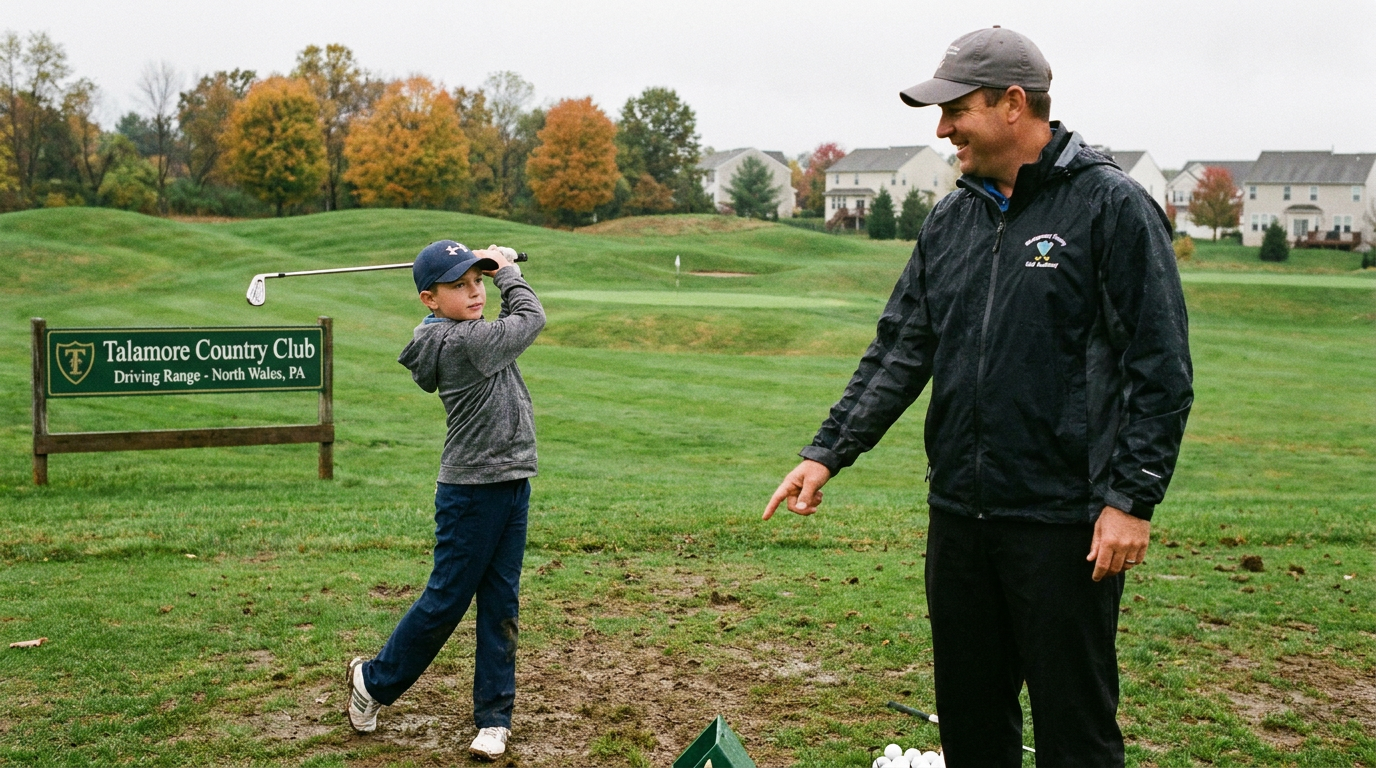
So how do you choose? Match the format to the goal, not the other way around:
- One private lesson — perfect for a specific diagnosis: “Why do I slice?” “Why am I hitting it fat?” One session, one answer, one practice plan.
- A multi-lesson package — the right call for a genuine swing change or a season-long improvement plan, where repetition and accountability do the heavy lifting.
- A clinic or small group — ideal for getting started (or restarted) in a low-pressure, lower-cost, social setting.
- Junior programs — for kids, prioritize fun, fundamentals, and an instructor with real youth development experience.
If you want to see how this maps to actual offerings and pricing, my current golf lesson rates and programs are published openly — the academy serves students from across Montgomery County, Bucks County, and the greater Philadelphia area, and I’d rather you walk in knowing exactly what everything costs than wonder. Transparency in pricing, by the way, is itself a signal worth watching for when you compare instructors: pros who publish their rates tend to be pros who are confident in their value.
And once the lessons start paying off, put your improving game to work — the tourism board publishes genuinely useful Montco Golf weekend itineraries featuring welcoming local layouts like Skippack Golf Course, which are perfect proving grounds for newer players taking their range game to the course.
We’ve now covered the whole evaluation: the local landscape, credentials, philosophy, technology, and program fit. Time to compress all of it into the practical tool you can actually carry into a phone call — a pre-booking checklist.
Your Pre-Booking Checklist: 7 Questions to Ask Any Montgomery County Golf Instructor
Everything in this article condenses down to seven questions. Ask them — by phone, by email, or in person — before you book with anyone, anywhere in the county. A great instructor will answer all seven easily and happily. Hesitation, vagueness, or annoyance is an answer too.
- Are you a PGA of America Member, and for how long? This is your credentials filter, and it takes ten seconds. Membership is verifiable and public. (My answer: PGA Member since 1997.)
- What’s your teaching philosophy, and how do you adapt it to different students? You’re listening for student-centered teaching versus a rigid method. If the answer describes one “correct” swing that everyone learns, and never mentions adapting to the student’s body, age, or goals, keep looking.
- What technology do you use in lessons — and how do you use it? The second half of the question is the important half. Toptracer, simulators, and video are wonderful tools, but only in the hands of someone who can interpret the data and translate it into a plan for you.
- Do you offer lesson formats that fit my goals and budget? Private lessons in multiple lengths, junior programs, group clinics, ladies’ clinics, multi-lesson packages — a real range of options means the instructor can match the format to your situation instead of forcing your situation into their one format.
- Will I leave each lesson with a practice plan? This might be the most predictive question on the list. Structured homework is where improvement actually happens; an instructor who doesn’t provide it is selling you lessons, not improvement.
- Can you teach year-round? In Pennsylvania, this matters enormously. Heated bays, covered hitting areas, and indoor simulators mean your progress doesn’t hibernate from November to March — and the off-season is often the best time for real swing work.
- Do you teach students like me? Be specific. If you’re a parent, ask about junior experience. If you’re a beginner, ask how they work with new golfers. If you’re a competitive player, ask about their track record with serious students. “I teach everyone” is fine; relevant, specific experience is better.
That’s the whole interview. Ten minutes, maybe less. And here’s what I want you to know from my side of the lesson tee: I welcome these questions, and so does every instructor worth hiring. Teaching professionals who are proud of their credentials, clear about their philosophy, and confident in their programs love talking about all three. Golfers searching for golf lessons in Montgomery County, PA should never feel awkward interviewing an instructor before committing — you’re not being difficult, you’re being a smart consumer making a decision that will shape years of your golfing life. If you’d like to run this checklist on me, get in touch with the academy and bring the list to our first conversation. I’ll enjoy answering every question on it.

The Best Investment a Montgomery County Golfer Can Make
Let me leave you with the thought I opened with, sharpened by everything in between. In a county with more than 50 golf courses and 300,000 yards of fairway, the scarce resource isn’t golf — it’s guidance. The instructor you choose will matter more to your game than any course you play, any driver you buy, or any tip you bookmark. Evaluate that choice on the five pillars we’ve covered: verified credentials, a student-centered philosophy, technology used with purpose, program fit for your goals and budget, and communication clear enough that you can explain your own lesson on the drive home. Get those five right and the improvement takes care of itself.
For more than two decades, I’ve had the privilege of doing this work in the same place: DCSJr Golf Academy at Lower State Road Golf Center, 500 Lower State Rd, North Wales, PA 19454 — teaching Montgomery County golfers year-round, through every season Pennsylvania can throw at us, on grass tees in July and in heated Toptracer bays in January. The faces change, the technology gets better, but the mission hasn’t moved an inch: help every golfer who walks onto my tee build the best version of their swing, and enjoy this game for life.
So bring me your questions — and your slice. I’ve seen both before.
Ready to stop guessing and start improving? Book your first lesson with PGA Professional David C. Smith Jr. at Lower State Road Golf Center in North Wales — right in the heart of Montgomery County. Contact DCSJr Golf Academy to schedule a lesson or ask a question. Not ready to book yet? View lesson rates and programs to find the format that fits your game, your goals, and your budget.