
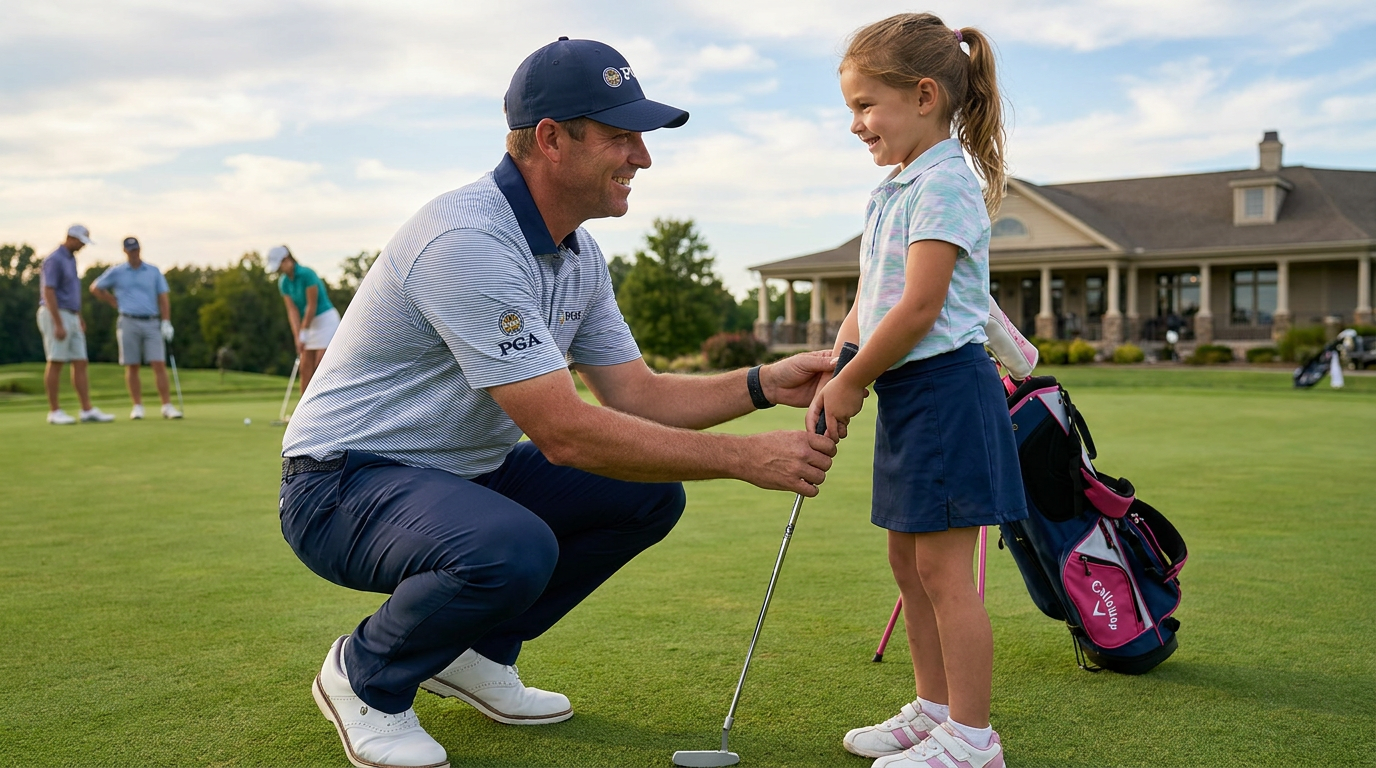
After more than two decades of teaching junior golfers, this is the question I hear most from parents: what age should my child start golf lessons? It comes at me over the phone, in emails at eleven o’clock at night, and from moms and dads standing at the edge of my lesson tee here in North Wales, Pennsylvania, watching another family’s kid roll putts and wondering if their own is ready. I’m David C. Smith Jr., a PGA Professional, and I’ve spent over twenty years helping kids fall in love with this game. So let me give you the answer I give every parent who asks.
The short, honest answer: most kids are ready for structured golf lessons around age 6 to 7. Kids as young as 3 to 5 can — and should — be introduced to golf through play. And it is genuinely, truly never too late to start.
But I know that behind the question about age, there’s a whole cluster of worries you’re not saying out loud. Am I starting too early and going to burn my kid out? Am I starting too late and they’ll never catch up? Will they hate it? Is it worth the money? I’ve heard every version of those worries, and I’ve watched how each one plays out over twenty-plus years of junior golf lessons. In this article, I’ll walk you through an age-by-age guide, the readiness signs that matter far more than a birthday, exactly what a kid’s first lesson actually looks like, and how you as a parent can help — or accidentally hurt — your child’s relationship with golf.
So what’s the real answer? Let me give it to you straight — the way I’d tell a parent standing next to me at the range.
The Honest Answer: It’s Less About Age, More About Readiness
Here’s the thing nobody puts on the brochure: the calendar is the least interesting tool I have for deciding whether a kid is ready for golf lessons. If you take nothing else away from this article, take this:
“Introduce golf as play from ages 3 to 5. Start structured lessons around 6 or 7. And if your kid is 10, 12, or 15 and just discovered the game? That’s still a fantastic time to start. Some of the best golfers I’ve ever coached picked up a club as teenagers.” — Dave Smith Jr., PGA Professional
Why do I say age alone is the wrong lens? Because I’ve stood on the lesson tee with two 6-year-olds, born three weeks apart, who might as well have been from different planets. One could stay locked into a putting game for half an hour, follow two-step instructions, and laugh off a whiff like it was the funniest thing that ever happened. The other was a wonderful kid who simply wasn’t there yet — his attention drifted after five minutes, and a missed shot felt like the end of the world. Same age. Completely different readiness. If I had made my decision based on their birth certificates, I’d have been wrong about at least one of them.
The pediatric experts back this up, by the way. The American Academy of Pediatrics, in its parent guidance on whether your child is ready for sports, notes that before age 6, most children haven’t yet developed the basic motor skills, attention span, and visual tracking that organized sports demand. By about age 6, most kids have the fundamental motor skills for simple organized sports — which is precisely why age 6 to 7 is my sweet spot for beginning structured instruction. The AAP’s clinical report on organized youth sports, published in Pediatrics, reinforces the same conclusion from the research side. When the doctors and the guy who’s taught a few thousand junior lessons independently land on the same answer, you can trust it.
Now, let me kindly bust a myth, because someone in your life has probably already brought it up. Yes, Tiger Woods was swinging a club at age 2. Yes, it worked out fine for Tiger. But prodigy stories are outliers by definition — they make great television precisely because they’re rare. For every early-start superstar, there are countless kids who were pushed into rigid instruction at 3 or 4 and quit the game before they hit middle school. The research on early sports specialization actually argues against pressure-cooker starts; pediatric sports medicine consistently favors broad, playful, multi-sport childhoods over single-sport intensity at young ages. Your 4-year-old does not need a swing coach. Your 4-year-old needs a plastic club, a foam ball, and a backyard.
If you want one sentence to carry out of this section, here it is: if your child can follow simple directions, stay engaged with one activity for 20 to 30 minutes, and — this is the big one — actually wants to swing a club, they’re ready for lessons. Notice that nothing in that sentence mentions a number of candles on a birthday cake.
That said, what golf looks like at 4 is completely different from what it looks like at 14 — so here’s my age-by-age breakdown.
Junior Golf Lessons by Age: A PGA Pro’s Age-by-Age Guide
Every age brings something different to the lesson tee, and good junior golf instruction meets kids where they are — not where a curriculum says they should be. Here’s how I think about each stage, based on what I actually see summer after summer, and how the major junior golf organizations structure their own programs. Find your child below.
Ages 3–5: Play, Don’t Push
Every spring, a parent walks up to me with a 4-year-old hiding behind their leg and asks about lessons. And every spring, my answer is the same: at this age, golf shouldn’t look like lessons at all. It should look like play.
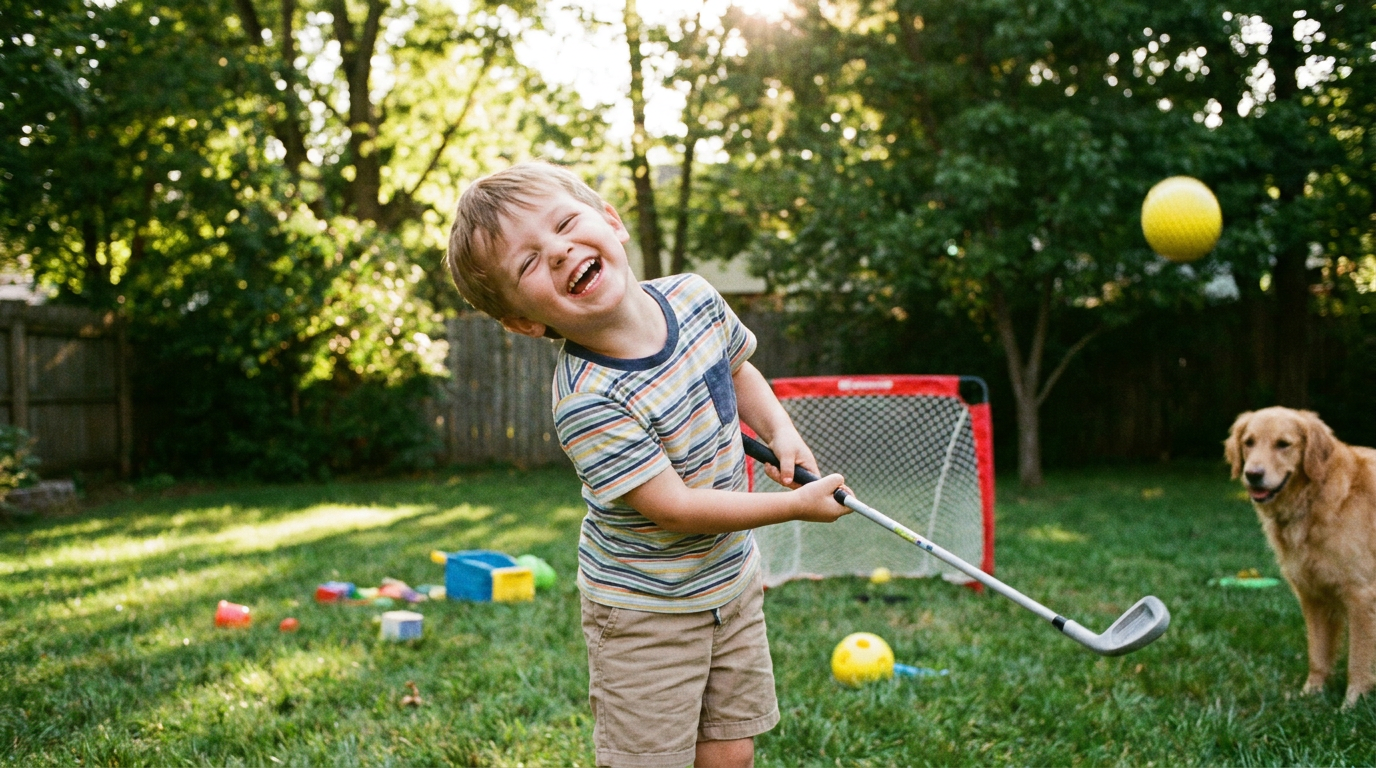
Here’s what golf at 3 to 5 should actually involve:
- Plastic or lightweight junior clubs — nothing heavy, nothing serious, nothing that requires “correct technique.”
- Backyard games — chipping foam balls at a bucket, putting contests on the living room carpet, hitting whiffle balls into a laundry basket.
- Ten-minute attention spans, honored — when they’re done, they’re done. Pack it in and get ice cream. The session was still a success.
- Zero mechanics talk — the words “swing plane” should not exist in your household yet.
The goal at this age is a single, powerful association: golf equals fun. That’s it. That’s the entire curriculum. U.S. Kids Golf’s own guidance for the 5-and-under crowd points the same direction — minimal instruction, maximum fun. A preschooler who giggles every time they whack a foam ball is building something more valuable than a repeatable takeaway: they’re building the desire to come back tomorrow.
If you want structure at this age, the best format I offer isn’t a solo lesson at all — it’s a Family Session, where a parent and child learn together. A 4-year-old paired up with mom or dad, playing games side by side, gets everything a formal lesson would give them and none of the pressure. I’ll talk more about Family Sessions later, because honestly, they’re one of my favorite things I do.
Ages 6–9: The Sweet Spot for Starting Lessons
This is the window. Somewhere between 6 and 9, I watch it click into place for almost every kid: the motor skills arrive, the listening improves, the focus stretches from ten minutes to thirty, and suddenly the child who was doing cartwheels on the putting green last year is asking me why her ball curves. It’s one of the most rewarding transformations in coaching.
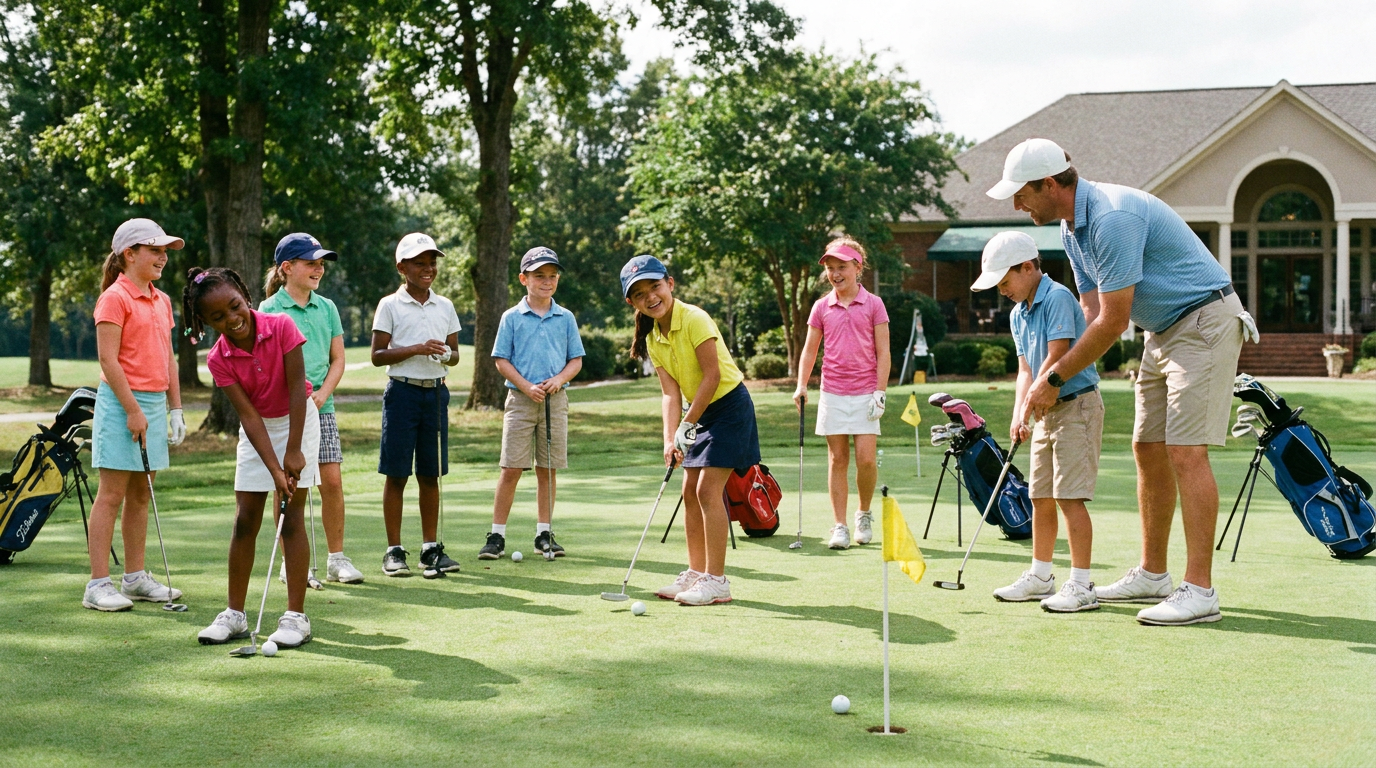
This isn’t just my observation — it’s the industry consensus. PGA Jr. League, the largest team-golf program for kids in the country, structures its youngest division as 9U, welcoming golfers nine and under into fun, low-pressure team play. First Tee, the youth development organization that has introduced millions of kids to golf, starts its core programming at ages 7 to 9. When the two biggest names in junior golf both plant their flag in this age range, it tells you something: this is when structured youth golf lessons genuinely begin to work.
What do good beginner junior golf lessons look like at this age?
- Short and game-based. Thirty to forty-five minutes of stations, challenges, and contests — not a lecture with a driver in hand.
- Fundamentals through feel. Grip, setup, and balance taught through simple images and games, not positions and checkpoints.
- Properly fitted lightweight clubs. A junior set that fits your child matters enormously. More on this in the FAQ, but the short version: never hand a 7-year-old a cut-down adult club and call it a day.
- Celebration of effort. At this age, I praise the kid who tried the hard shot and missed far louder than the kid who played it safe.
If your child is in this range and showing the readiness signs I’ll cover in the next section, this is the moment to get them started. You can see how I structure junior and group lesson programs at DCSJr Golf Academy — from group clinics that make golf social to private lessons for kids who thrive on one-on-one attention.
Ages 10–13: Skills, Strategy, and (Friendly) Competition
By 10, something wonderful happens: kids can think about golf, not just do it. A 12-year-old can understand why you’d lay up short of a creek. She can learn the rules, keep an honest score, read a green, and — crucially — handle real technique work without her eyes glazing over. This is when junior golf instruction gets to go deeper.
At this stage, my lessons start to include:
- Genuine technique refinement — we can now talk about ball flight, face angle, and why the ball does what it does, in kid-friendly language.
- Course management — golf’s chess game. Kids this age love strategy once they realize it exists.
- Rules and etiquette — not as a boring lecture, but as the code that makes them feel like real golfers.
- Friendly competition — team formats, match play games, and closest-to-the-pin contests that make competition feel like recess.
This is also prime PGA Jr. League territory — the 13U division is built exactly for this age group, wrapping competition in a team jersey and a scramble format so no single kid ever carries the weight of a bad hole alone. I’ve watched shy 11-year-olds transform into confident competitors over a single PGA Jr. League season, purely because the team format made competing feel safe.
The other big development at 10 to 13: practice habits start forming, for better or worse. The kids who learn how to practice at this age — short, focused, playful sessions rather than mindless bucket-beating — carry that skill for life.
Ages 14–17: It’s Not Too Late — It’s Prime Time
Let me speak directly to the parent reading this with a knot in their stomach because their kid is 14 and has never held a golf club: you have not missed the window. There is no window.
In fact, I’d argue teens are some of my fastest learners. Here’s why:
- They’re physically capable. A 15-year-old can generate real clubhead speed and control it in ways a 8-year-old simply can’t.
- They can process instruction. Abstract concepts, cause-and-effect, video feedback — teens absorb it all quickly.
- They’re self-motivated. A teenager who chooses golf practices harder than a 7-year-old who was signed up for it.
- They have clear goals. Making the high school golf team is one of the most powerful motivators I’ve ever coached toward — and it’s an absolutely achievable goal for a dedicated beginner.
Every year, I work with teens building swings from scratch for their high school teams, and every year some of them go from “never played” to “varsity contributor” faster than anyone expected. PGA Jr. League’s 17U division keeps the fun team format available right through the teenage years, so competition never has to feel like a solo pressure cooker.
Golf is one of the only sports where a 14-year-old beginner is not behind — because golf isn’t a sprint against other kids’ head starts. It’s a lifetime game, and your teen has more of that lifetime ahead of them than any of us.
Age bands are useful, but every summer I meet a 5-year-old who’s ready and an 8-year-old who isn’t. Here are the signs I actually look for.
5 Readiness Signs That Matter More Than a Birthday
When a family comes to see me for the first time, I’m not looking at the child’s age. I’m looking for five specific things — and you can look for all of them at home, this week, without setting foot on a golf course. Consider this your pre-lesson checklist.
- Attention span. Can your child stay engaged with a single activity for 20 to 30 minutes? Not sit still — engaged. Building Legos, doing a puzzle, playing a board game to the end. Golf lessons are active and playful, but they still require a kid to stay with one thing for a stretch.
- Basic coordination. Can they run, balance on one foot, catch a bounced ball, and track something moving through the air? These are the same fundamental motor skills the American Academy of Pediatrics points to for organized sports readiness. A child doesn’t need to be athletic — they just need the basic building blocks the swing will be built on.
- Follows simple instructions. Can they handle a two-step direction — “put the ball on the tee, then take your setup” — without frustration? Coaching is a conversation, and the child needs to be able to hold up their half of it.
- Handles small failures. This one matters more in golf than in almost any other sport. Golf is a game of misses. Even Scottie Scheffler hits shots he hates every single round. If your child can whiff, laugh (or at least shrug), and try again, they’re emotionally ready for golf. If a miss triggers a meltdown, that’s not a character flaw — it just means we wait a bit.
- They ask to play. Here is the single biggest predictor of whether a kid will love golf for life: the interest comes from them. They grab your putter in the garage. They watch golf on TV for more than thirty seconds. They ask when they get to go to the range. When the desire is theirs, everything I teach lands ten times better.
“I can teach a grip in ten minutes. I can’t teach a kid to want to be there — that has to come first.” — Dave Smith Jr.
What if your child isn’t showing these signs yet? Then here’s my honest, judgment-free advice: wait six months. That’s it. No drama, no falling behind, no missed opportunity. Keep golf playful at home — foam balls in the yard, putts on the carpet, a trip to a par-3 course where the only rule is fun. Or come do a Family Session with me, where the low-pressure format works beautifully for kids who aren’t ready to fly solo. Six months in a child’s development is an eternity; the kid who wasn’t ready in April is often more than ready by October.
And if you’re genuinely unsure whether your child is ready? Just ask. Send me a note with your child’s age and a sentence or two about them, and I’ll give you my honest take — even if my honest take is “give it a few more months.” I’d rather earn your trust than your booking.
If you’re nodding along to most of those signs, the next question is obvious: what actually happens in a kid’s first golf lesson?
What Kids Golf Lessons Actually Look Like (Hint: Not a Lecture)
I think some parents imagine a first golf lesson as a miniature military academy — a stern pro drilling a nervous kid on wrist angles while the child fights back tears. Let me put that image to rest. Come stand on the tee with me for an hour and here’s what you’d actually see.
The first ten minutes: welcome and warm-up games. Before we touch a golf swing, we play. Balance games, target tosses, maybe a putting contest where the kid gets to pick the prize (bragging rights are surprisingly valuable currency). This isn’t stalling — it’s the most important part of the lesson. I’m learning how this particular kid moves, listens, and reacts, and the kid is learning that this place is fun and this coach is on their side.
The middle: grip, setup, and lots of swings. Here’s a trade secret — I can teach a functional grip and setup to a 7-year-old without ever using the words “grip” or “setup.” We shake hands with the club. We stand like a shortstop. We make the ball fly to the picture on the fence. Kids learn through feels and images, not mechanics-speak, so that’s the language I use. Then we swing. A lot. Because the kid who takes sixty swings and laughs forty times learns more than the kid who takes ten perfect rehearsals in silence.
The last five minutes: a win, and a debrief. Every lesson ends with a challenge the child can succeed at — a putt they make, a chip that lands on the towel, a drive that clears the marker. Kids should walk off the tee feeling ten feet tall. Then I spend two minutes with you, the parent: here’s what we worked on, here’s what to play with at home, here’s what I’m seeing. No jargon, no homework packets. Just a coach and a parent on the same team.
How is this different from adult lessons? In almost every way. Kids’ coaching runs in shorter blocks, because attention is a resource we spend wisely. It’s built on games and challenges, because competition-with-a-smile is how children engage. It uses external targets — “make the ball curve around that flag” — instead of internal positions, because that’s how young brains actually learn motor skills. And it celebrates effort over outcomes relentlessly, because the kid who’s praised for trying keeps trying.
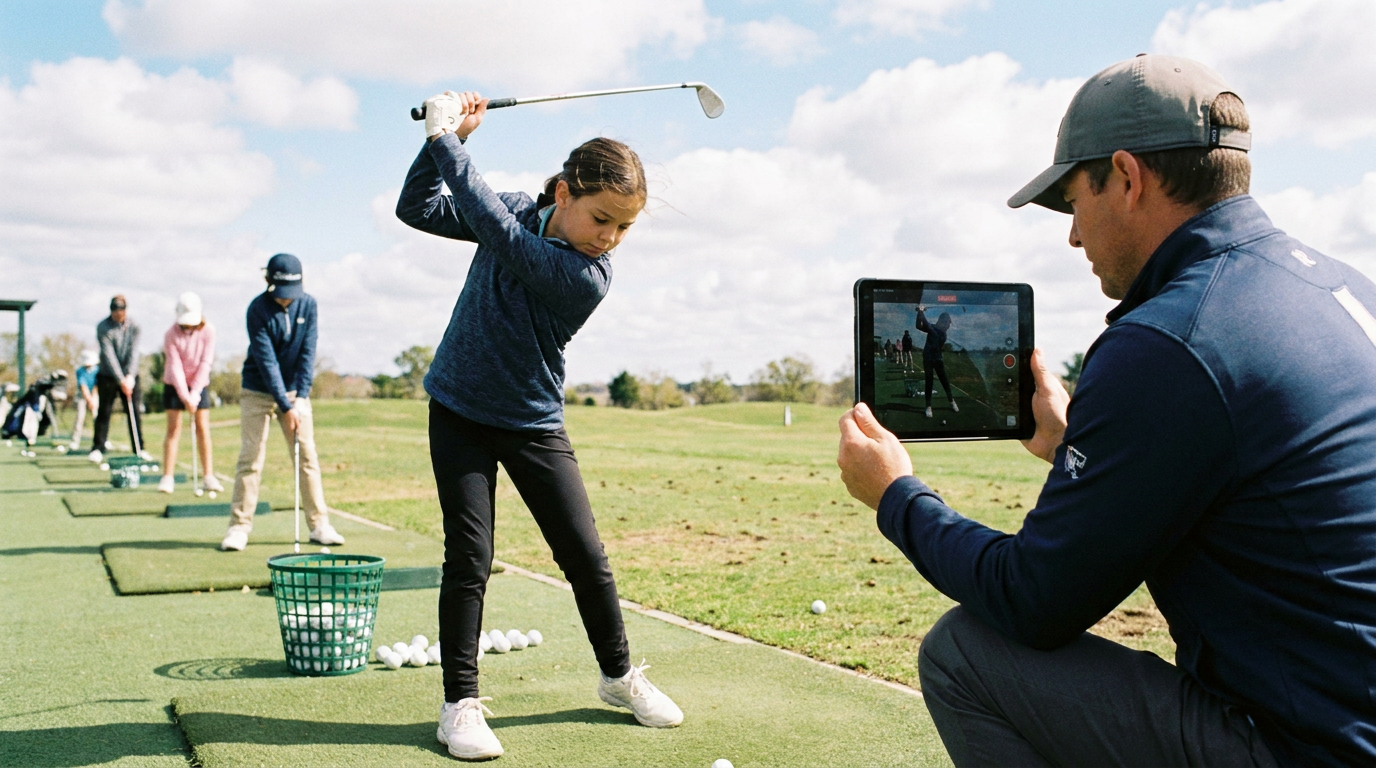
What about technology? For older juniors — usually the 10-and-up crowd — I bring in video instruction and swing analysis, and it’s a game-changer when used right. A 12-year-old watching her own swing on a tablet, side by side with last month’s version, sees her progress in a way no amount of coach-talk can convey. The key phrase is used right: video is a highlight reel of progress, not a catalog of flaws. I use it sparingly and age-appropriately, so kids see how far they’ve come without drowning in information they don’t need yet.
And practice between lessons? At young ages, practice should look suspiciously like play. Ten minutes of putting contests in the hallway beats an hour of forced range time every single week. There’s also a deeper truth here that surprises most parents: kids who are improving fastest often look messiest in the middle of the process. Learning is supposed to look wobbly. I wrote a whole piece on this idea — Performance vs. Learning in Golf Practice — and if you read one more article after this one, make it that, because it will change how you watch your kid practice.
The logistics, quickly, because I know you’re wondering: junior lessons typically run shorter than adult sessions and are scaled to the child’s age and attention. I offer both group formats (great for fun and social stickiness) and private junior golf lessons (great for focused progress), and you can find the details on my lesson rates and programs page. What should you bring to a first lesson? Honestly: enthusiasm. If you have questions about equipment or whether your child’s current clubs will work, just ask when you book — don’t buy anything new beforehand.
I teach out of North Wales, PA, and work with families from all over Montgomery County, Bucks County, and the greater Philadelphia area. If you’ve been searching for kids golf lessons near you and you’re anywhere in this corner of southeastern Pennsylvania, chances are good we’re neighbors.
Of course, the coach only has your child for an hour a week. The other 167 hours? That’s where you come in — and where well-meaning parents often go wrong.
The Parent’s Role: How to Help Without Becoming That Golf Parent
In twenty-plus years, I’ve watched a thousand parent-and-kid dynamics play out on and around my lesson tee. I’ve seen parents whose quiet support turned a hesitant beginner into a lifelong golfer, and I’ve seen — with a heavy heart — parents whose intensity drove a genuinely talented kid out of the game by thirteen. The difference between those outcomes almost never comes down to the kid. So let me coach you for a minute, with love.
The do’s:
- Model enthusiasm. If golf looks like something you enjoy, your kid will want in. If it looks like something you stress about, they’ll notice that too.
- Celebrate effort and etiquette, not scores. “You fixed your own divot without being asked” is a bigger win at age 8 than any number on a card.
- Master the car ride home. After a round or a lesson, your child needs exactly one sentence from you: “I loved watching you play.” That’s it. Not a shot-by-shot review. Not “what happened on seven?” Just that. It’s the most powerful sentence in youth sports.
- Make golf family time. Nine holes together, a putting contest before dinner, a hot dog at the turn. Shared joy is the glue.
The don’ts:
- Don’t sideline-coach over my shoulder. When a kid gets instruction from two directions at once, they end up trusting neither. Let the lesson be the lesson.
- Don’t compare. Not to siblings, not to teammates, not to the kid two stalls down who’s crushing it. Every junior golfer is on their own timeline.
- Don’t force range time. Mandatory practice is how golf becomes a chore. Invited practice is how it becomes a passion.
- Don’t chase early specialization. Pediatric sports medicine has been waving this flag for years: single-sport pressure at young ages raises burnout and injury risk, while multi-sport childhoods build better athletes and happier kids. Let your junior golfer also be a soccer player, a swimmer, a tree-climber. Golf will still be here.
“The fastest way to make a kid quit golf is to make it feel like homework. The fastest way to make them love it is to play nine holes with them and buy them a hot dog at the turn.” — Dave Smith Jr.
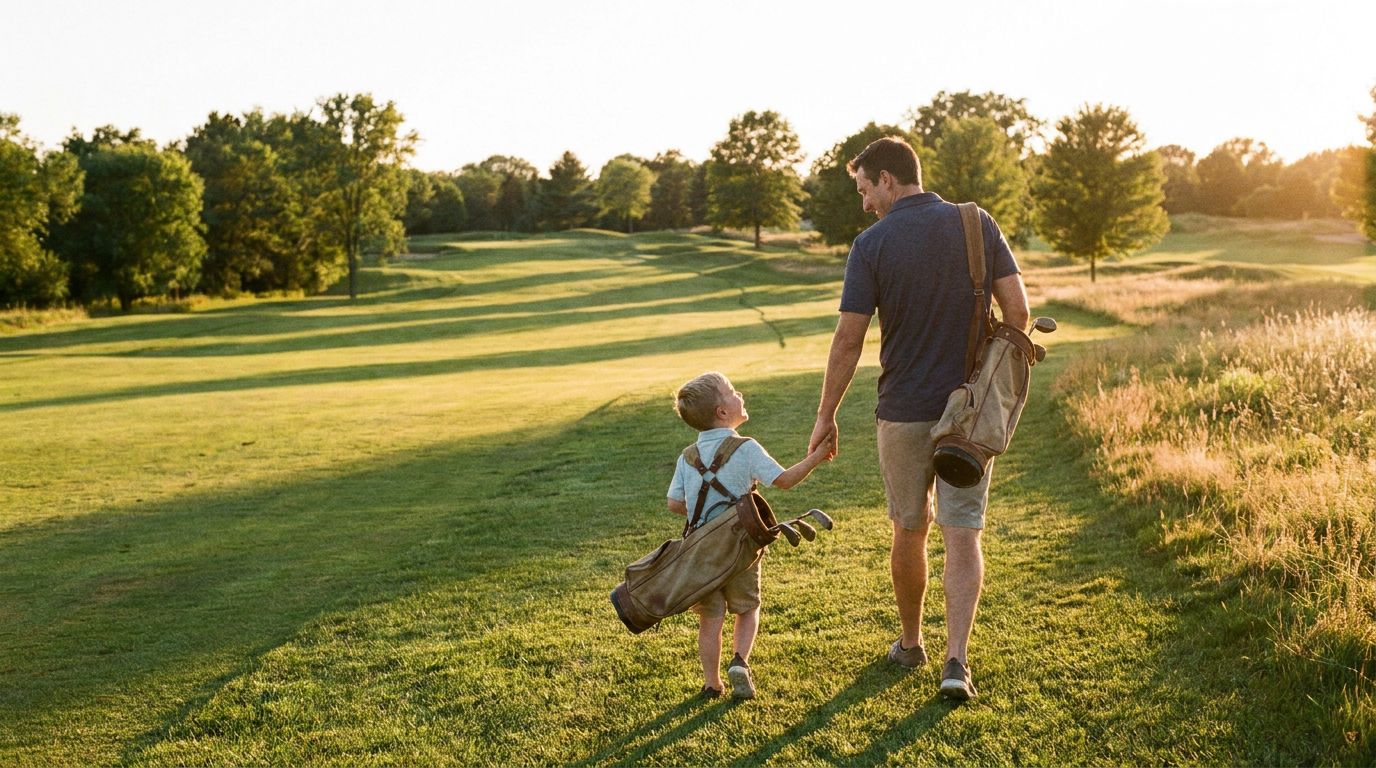
Now, here’s the part I get genuinely excited about, because it solves nearly every “don’t” on that list in one stroke: Family Sessions. In a Family Session at DCSJr, the parent and child learn together — same tee, same games, same laughs. And something almost magical happens to the family dynamic. The parent stops being the critic in the folding chair and becomes a playing partner. The kid stops performing for approval and starts sharing an adventure. I’ve watched dads discover their swing needs more work than their daughter’s (humbling, and hilarious), and I’ve watched moms and sons build a Saturday-morning ritual that outlasted every other activity on the family calendar. For kids under 7 and for hesitant beginners of any age, a Family Session is often the single best format I offer — you can find them alongside all my junior and family lesson options.
And this points to something genuinely special about golf that I want every parent to appreciate: it’s one of the very few sports families actually play together — not watch from the bleachers, but play, side by side — for decades. Your child will age out of youth soccer. They’ll never age out of a Sunday nine with you. Organizations like First Tee have built their whole model around this bigger truth: golf isn’t just teaching kids a swing, it’s teaching honesty, patience, and resilience with a scorecard attached. The swing is the smallest thing your child will take from this game.
Before you book anything, let me rapid-fire through the questions parents ask me every single week.
Junior Golf FAQ: A PGA Pro Answers Parents’ Most Common Questions
Is 5 too young for golf lessons?
Not for the right kid in the right format. A play-based introduction or a Family Session with a parent alongside? Wonderful at 5. Rigid, solo, technical lessons? Too much, too soon. If your 5-year-old is asking to play and can stay engaged through a few putting games, a low-pressure format is a great start — and if they’re not there yet, six more months of backyard fun costs you nothing.
Is 12 (or 15) too late to start golf?
Absolutely not — and I’d say that with a smile even if it weren’t good for business. Teens often progress faster than younger kids because they’re stronger, they process instruction better, and they’ve chosen the game themselves. I’ve coached plenty of teenage beginners onto high school golf teams. There is no missed window in golf; there’s only the day you start.
Do kids need their own golf clubs for lessons?
What matters is age-appropriate, lightweight junior clubs — brand matters far less than fit. Please don’t hand your child cut-down adult clubs; they’re too heavy and too stiff, and they teach kids compensations we then have to un-teach. Best move of all: ask your coach before buying anything. I’d much rather help you choose right the first time than watch you spend twice.
Group lessons or private junior golf lessons — which is better for beginners?
Both work; they just work differently. Group lessons bring fun, friends, and the social stickiness that keeps kids coming back — golf buddies are powerful motivators. Private lessons deliver focused, personalized progress. In my experience, many juniors thrive on a mix: group clinics for energy and community, with the occasional private session to sharpen specifics.
What is PGA Jr. League and when can my child join?
PGA Jr. League is team golf for kids — jerseys, scramble formats, and coaching from PGA Professionals, designed so no child ever shoulders a bad hole alone. Players are grouped into three age divisions: 9U for golfers nine and under, 13U, and 17U. If your child loves the idea of being on a team, it’s one of the best entry points into competitive golf that exists.
How often should a kid practice golf?
Little and often beats marathon sessions, every time. Ten to fifteen playful minutes a few times a week will outperform a forced two-hour range session — and your child will still like golf afterward, which is the entire point. At young ages, remember: practice should look like play. If it looks like homework, dial it back.
Have a question I didn’t cover here? Ask me directly — I answer every message myself. And if you like straight answers about golf, the DCSJr Insights blog has plenty more where this came from.
If you’ve read this far, you already know the answer isn’t really about age at all — so here’s the bottom line.
The Bottom Line on What Age to Start Golf Lessons
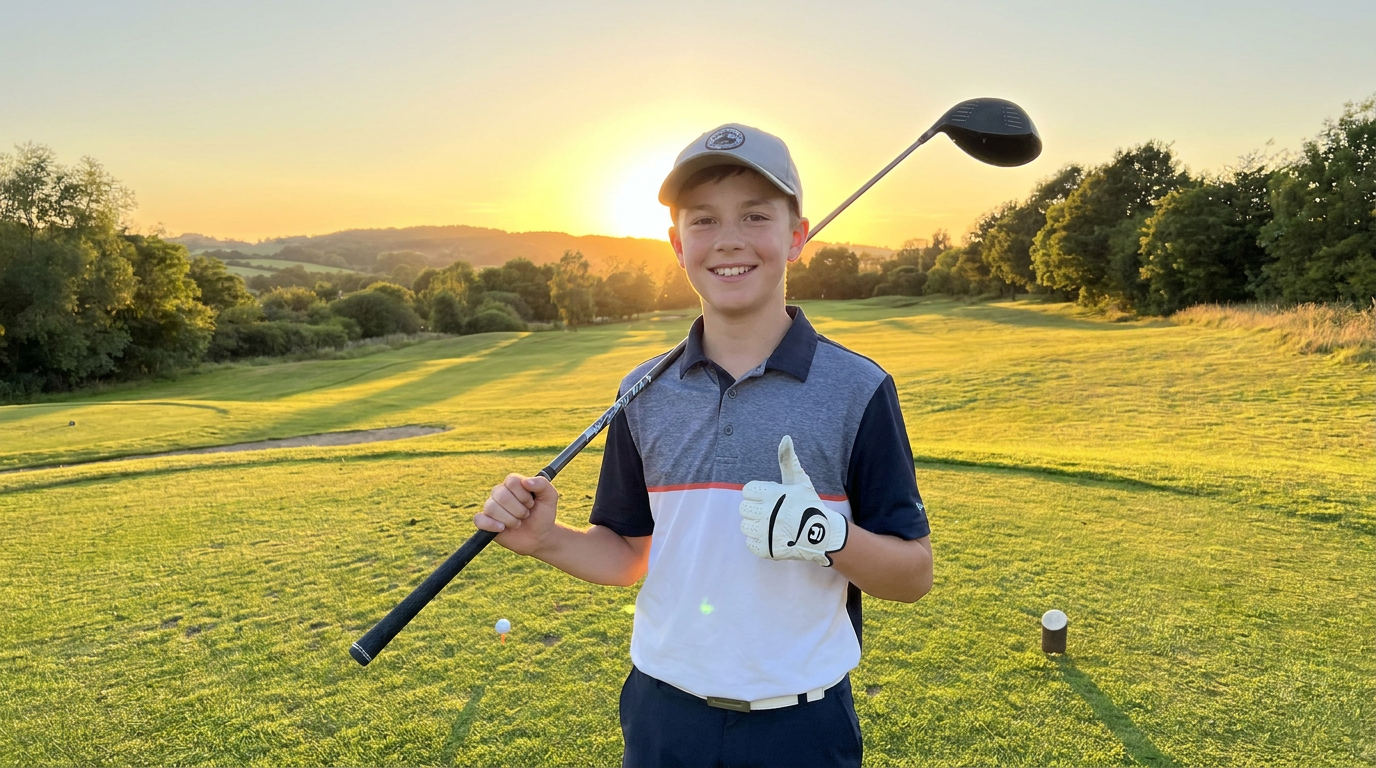
Here’s everything above in two sentences. Introduce golf as pure play from ages 3 to 5, begin structured lessons around 6 to 7, and know with total confidence that starting at 10, 12, or 15 is not late — it’s just a different door into the same great game. Readiness and enthusiasm beat birthdays, every single time, so run your child through the five-sign checklist above, and let that be your answer instead of a number.
And here’s the bigger truth I’ve learned across two decades of junior golf lessons, the one I hope you carry out of this article: the goal was never a scholarship. The goal is a kid who still wants to play golf with you when they’re 40 — who calls on a Thursday and says “tee time Sunday?” because somewhere back in childhood, this game became something your family shares. Every lesson, every foam ball in the backyard, every hot dog at the turn is a small deposit into that account.
Ready to see if your child is ready? Book a Junior Golf lesson or a Family Session with me at DCSJr Golf Academy in North Wales, PA — I work with families across Montgomery County, Bucks County, and the greater Philadelphia area. You can explore junior lesson programs and rates or simply get in touch to book. There’s no long-term commitment and no pressure — just an hour on the tee to see if your child lights up. In my experience, that hour tells us everything we need to know.
Not quite ready yet? That’s a perfectly good answer too. Join the DCSJr newsletter and I’ll keep you stocked with junior golf tips and program updates until the timing feels right — whether that’s next month or two summers from now.
See you on the tee.
— David C. Smith Jr., PGA Professional · Read my story