
You’ve done it. You’ve finally decided this is the season you stop guessing and start improving. So you open Google, type “golf lessons Philadelphia,” and hit enter — and what comes back is a wall of directories, five-year-old forum threads, star ratings from strangers, and a dozen listings that all somehow claim to be the best. Twenty minutes later, you close the laptop knowing less than when you started.
I’ve watched that exact scenario play out for years, and it’s why I’m writing this guide. My name is David C. Smith Jr. I’m a PGA Professional — a PGA Member since 1997 — and I’ve spent more than two decades teaching golfers of every age and ability at DCSJr Golf Academy, based at Lower State Road Golf Center in North Wales, PA. If you’re searching for golf lessons in Philadelphia, I want to give you something those directories can’t: an honest, insider’s roadmap from someone who actually stands on the lesson tee every day.
This is the advice I give friends and family when they ask me how to find a good instructor. It covers what credentials actually matter, what lessons should realistically cost in our area, what improvement you can genuinely expect, and — maybe most importantly — how to know whether an instructor is right for you. Not right in general. Right for you, your goals, your schedule, and your game.
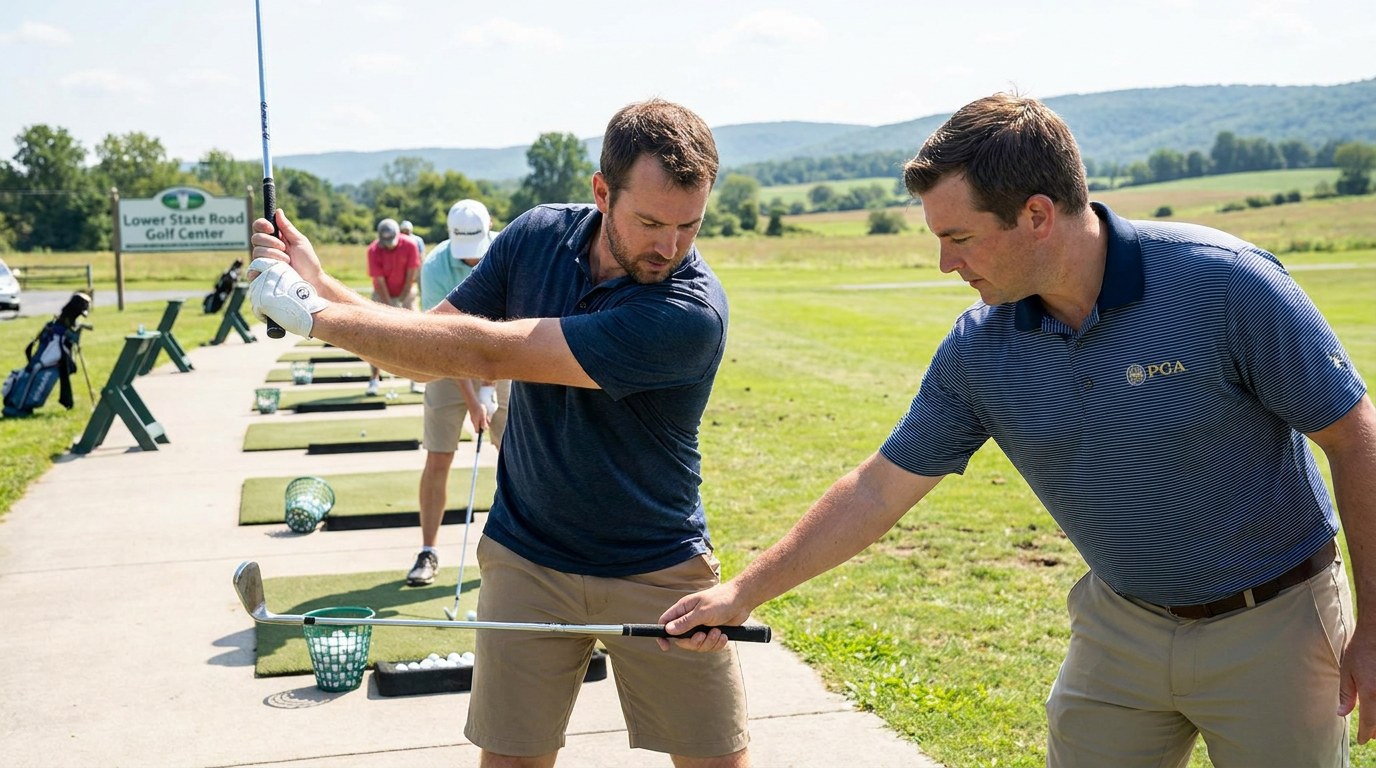
I’ll be straight with you from the start: yes, I teach golf for a living, and yes, I’d love to work with you someday. But this guide will be just as useful if you never set foot on my lesson tee. My goal is simple — by the end of this article, you’ll know exactly how to separate a genuinely qualified golf instructor from someone who just printed business cards, and you’ll never feel lost in a search results page again.
Because here’s the frustrating truth about that search: the reason it feels so overwhelming isn’t that there are too many options. It’s that nobody in those results is actually teaching you how to choose. And while you’re stuck deciding, your game is stuck too — which brings me to the first thing every Philadelphia golfer needs to hear.
Why Most Philadelphia Golfers Stay Stuck (And Why YouTube Isn’t the Answer)
Let me describe a golfer to you, and tell me if this sounds familiar. He watches swing videos on his phone during lunch. He’s tried the towel-under-the-arm drill, the flying wedge, shallowing the club, standing closer to the ball, standing farther from the ball. Every range session starts with a new idea and ends with the same slice. He’s not lazy — he’s putting in real time. He’s just not getting anywhere.
I meet this golfer constantly. In fact, over 20-plus years of teaching, he might be the single most common new student who walks into my academy. And I want to say clearly: it’s not a talent problem. It’s not even an effort problem.
“Most golfers don’t have a talent problem — they have a feedback problem. You can’t fix what you can’t see, and you can’t see your own swing.”
That’s the trap of what I call tip-hopping. YouTube instruction — even genuinely good YouTube instruction — is generic by definition. The person on your screen has never seen your swing, your body, your grip, your misses, or your history. A tip that’s a cure for one golfer is poison for another. Telling a golfer who already slides too hard toward the target to “shift your weight” is like handing a sunburned man a tanning lamp. The information isn’t wrong; it’s just wrong for him. And without someone watching, he has no way to know.
The numbers back this up in a way that surprises most people. According to Golf Digest’s analysis of USGA handicap data, the average male handicap in America improved from 16.3 to 14.4 over a 25-year span — less than two strokes in a quarter century. Think about that. Twenty-five years of better equipment, better balls, better course conditioning, and infinite free instruction online… and the average golfer got 1.9 strokes better. If free tips and new drivers were the answer, we’d all be scratch by now.
Now contrast that with what happens when golfers get structured help. Golf Insider ran a data study of 257 club golfers, tracking who improved over 12 months and who didn’t. The golfers who improved the most shared a clear pattern: they took lessons — averaging around four over the year — they practiced with a specific purpose, and they tracked their stats. The study found improvers reported 15% higher levels of focus and planning in their practice than golfers whose handicaps went backward. Four lessons. Purposeful practice. Measurement. That’s not a magic formula; it’s just structure — the exact thing self-taught golfers are missing.
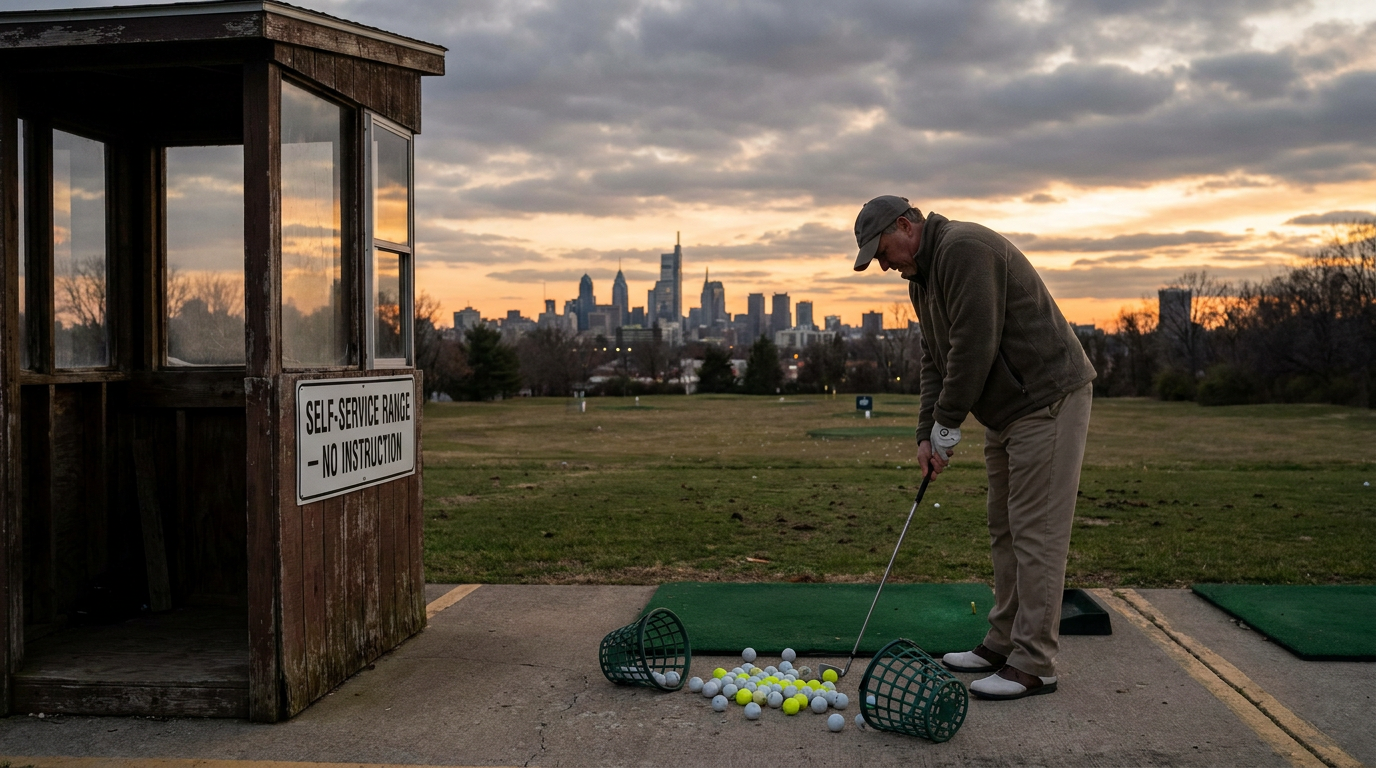
Here’s what I see on my end of that equation. When a golfer comes to me after five or ten years of self-teaching, I’m almost never looking at one swing flaw. I’m looking at an archaeology site — compensations layered on compensations. A grip change made in 2019 to fix a hook. A stance change made in 2021 to fix what the grip change caused. A weird little loop at the top that the golfer doesn’t even know exists, built subconsciously to save the shot at impact. None of it was chosen deliberately. All of it was the body’s honest attempt to solve problems without guidance. My job in that first lesson is often less about teaching something new and more about figuring out which layers to peel back — and in what order.
There’s one more distinction I want you to understand, because it changes how you practice forever: the difference between practicing to perform and practicing to learn. Most golfers go to the range and try to hit good shots. That feels productive — but hitting the same comfortable 7-iron to the same flag with no consequences is performing, not learning. Real learning practice is often uglier: slower swings, exaggerated feels, deliberate misses, drills that feel awkward for two weeks before they feel natural. I’ve written about this in depth in my piece on performance vs. learning in golf practice, and it’s a concept that separates golfers who improve from golfers who just stay busy.
And here’s the Philadelphia-specific kicker: our season is short. A golfer in Arizona can waste a hundred range sessions and still have three hundred more. Around here, between the March mud and the November frost, you might get thirty or forty real practice windows a year. Every unfocused, feedback-free range session in this region costs proportionally more than it does almost anywhere else in the country. When your season is precious, structure isn’t a luxury — it’s the only rational approach.
So if the case for lessons is this strong, the next question is obvious and important: who do you actually trust to teach you? That’s where credentials come in — and where most golfers have never been told what the letters actually mean.
What a PGA Certified Golf Instructor Actually Is (And Why It Matters)
Here’s something that surprises almost everyone I tell: in the United States, there is no legal requirement to hold any credential whatsoever to charge money for golf lessons. Anyone — literally anyone — can print business cards tomorrow that say “Golf Instructor,” rent time at a range, and start teaching. No test. No training. No oversight. The guy who shot 74 once in 2014 and the professional who has spent decades studying the swing are, in the eyes of a Google search result, identical listings.
That’s why the PGA credential matters, and why I want to take a few minutes to demystify it — because once you understand what it takes to earn, you’ll never look at an instructor listing the same way again.
Becoming a PGA of America Golf Professional is not a weekend certification. The path to PGA membership involves several demanding stages:
- The Playing Ability Test (PAT). Before anything else, you have to prove you can actually play. The PAT requires shooting a target score across 36 holes in a single day — a standard that a large percentage of attempts fail. You cannot teach the game at the PGA level without demonstrating you can perform in it.
- The PGA Professional Golf Management program. A multi-year, multi-level education program covering swing instruction, teaching methodology, club fitting, rules, business operations, player development, and more — with testing at every level.
- Work experience requirements. Candidates must log substantial, verified employment in the golf industry under qualified supervision. You don’t study your way into the PGA from a couch; you earn it on the tee and in the shop.
- Ongoing education. Membership isn’t a trophy you win once. PGA Professionals are required to continue their education throughout their careers to maintain their standing.
I went through that process and earned my PGA membership in 1997. I can tell you honestly that it changed how I thought about teaching. Before the program, I knew what worked for my swing. After it, I understood why things work, why they fail, and — most importantly — why the same fix lands completely differently on different bodies and different minds. And that education never really stopped. The way I taught in 1997 is not the way I teach today. Video technology, launch data, our understanding of how people actually acquire motor skills — the field has evolved enormously, and staying current is part of the job. A credential earned nearly three decades ago is only worth something because it came with the obligation to keep learning.
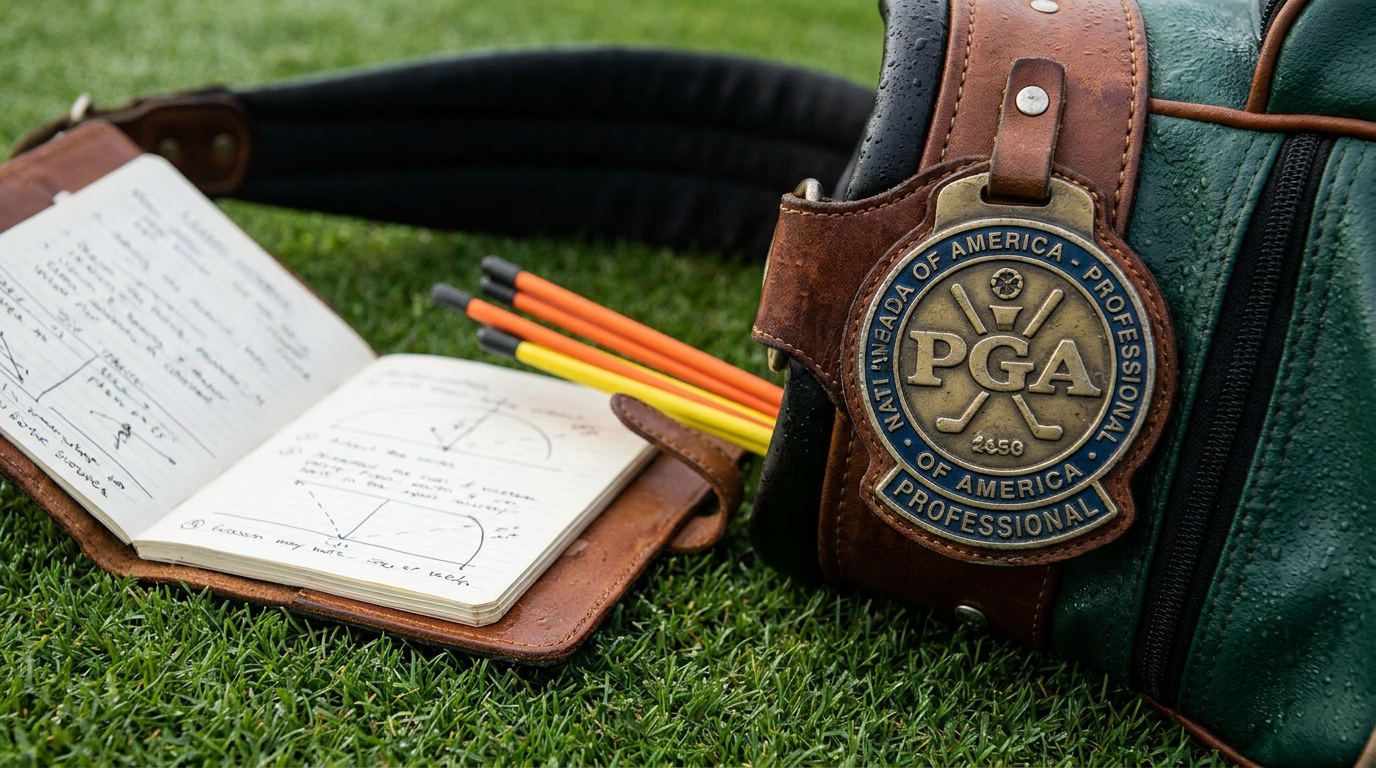
There’s also a local dimension to this that most golfers never think about. PGA Professionals aren’t lone operators — we belong to regional sections that function as professional communities and standards bodies. The Philadelphia PGA Section covers eastern Pennsylvania, southern New Jersey, and Delaware, and includes nearly 900 PGA Professionals. That network means shared education, professional accountability, and a community of peers. When you hire a PGA Professional in this region, you’re not just hiring an individual — you’re hiring someone connected to a body of standards and colleagues who take the craft seriously.
So here’s the practical takeaway, and I’d frame it exactly this way: when you search for a golf instructor in Philadelphia, the PGA credential is your quality filter. It doesn’t guarantee that every PGA Professional is the perfect teacher for you — chemistry and specialization still matter, and we’ll get to those. But it does guarantee a tested, educated, accountable baseline that “golf instructor” alone never can.
How to verify any instructor’s PGA status in 60 seconds: Don’t take a website’s word for it — check the source. The PGA of America maintains its own directory of verified coaches at PGA.com. Search the instructor’s name; if they’re a member in good standing, they’ll be there. You can see my own verified profile — David C. Smith Jr., PGA — right on PGA.com. Any legitimate PGA Professional will be happy you checked. If someone’s marketing implies a credential you can’t verify, that tells you everything you need to know.
If you’d like the longer version of my own story — how I got into teaching, what my coaching philosophy looks like after two decades on the lesson tee — you can read more about me here. But I’ll say this much: earning that membership in 1997 remains one of the proudest achievements of my professional life, not because of the card in my wallet, but because of what it demanded of me and what it still demands.
A credential, though, is the starting line — not the finish line. Plenty of golfers have hired credentialed instructors and still had mediocre experiences, because the credential is only one item on the checklist. So let me give you the rest of it: the exact criteria I’d use if I were the one shopping for lessons.
How to Vet a Golf Instructor: A PGA Pro’s Own Checklist
Let’s flip the script. Imagine I’m not an instructor — imagine I’m a 15-handicap in Chestnut Hill looking for golf lessons near me in the Philadelphia area, with a budget, a busy schedule, and a slice I’ve hated for a decade. How would I actually evaluate my options? Here’s my honest checklist — the same standard I’d want any prospective student to hold me to.
Start with verification, then move past it quickly. You already know how to confirm a PGA credential from the previous section, so do that first and treat it as your entry filter. But once you’ve confirmed it, the credential has done its job. Everything after this point is about fit.
Look for experience with your type of golfer. This is the most underrated factor in the entire search. Teaching a 7-year-old junior, a brand-new adult beginner, a 68-year-old with a fused lower back, and a college player chasing a scholarship are four completely different jobs. They require different communication, different drills, different pacing, and different definitions of success. Over my 20-plus years I’ve taught all of them — juniors, beginners, women taking up the game, seniors adapting their swings to changing bodies, and competitive players grinding over one degree of face angle — and I can tell you the approaches barely overlap. When you talk to a prospective instructor, don’t just ask “are you good?” Ask “how much of your teaching is with golfers like me?”
Demand diagnosis before prescription. This is my biggest red flag in the entire industry. If an instructor starts changing your swing in the first five minutes — before asking about your goals, your golf history, your injuries, your physical mobility, or what your typical miss looks like — walk away. A good coach is a diagnostician first. Your slice might come from your grip, your setup, your sequencing, or your hip mobility, and each root cause demands a different fix. Prescription without diagnosis isn’t coaching; it’s guessing with confidence.
Expect technology, because evidence beats opinion. Twenty years ago, a lesson was one person’s eyes and another person’s feels. Today, there’s no excuse for that. High-speed video analysis lets a student see what I see, which accelerates learning dramatically — golfers almost never feel what they’re actually doing, and the camera ends that argument instantly. At my academy, video instruction and swing analysis is built into how I teach, and I’d consider it a baseline expectation for any modern instructor you’re evaluating. If a prospective coach doesn’t use video or data at all, ask why. There may be a reasonable philosophy behind it — but there should be a philosophy, not just an old habit.
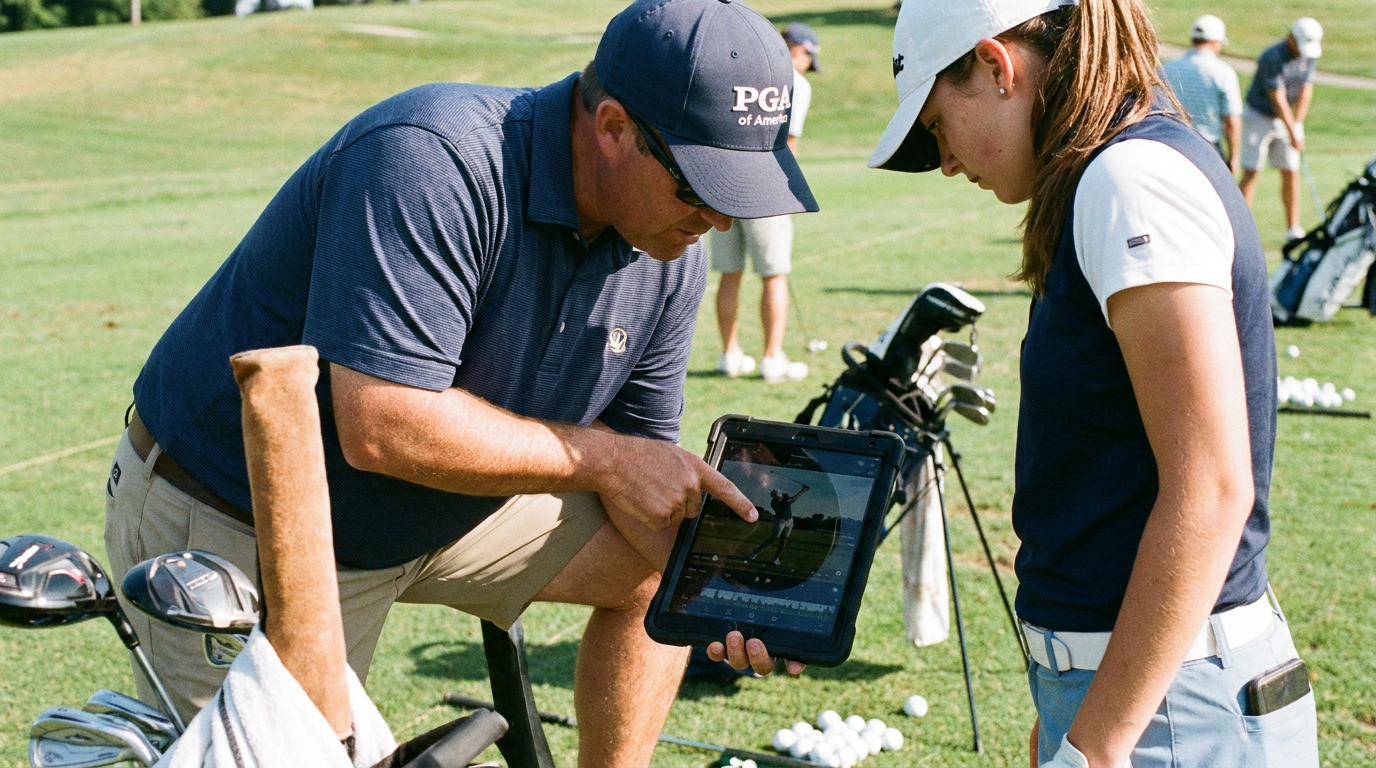
Insist on structure between lessons. A lesson is one hour. Your improvement happens in the other 167 hours of the week. The instructors who actually change games are the ones who send you home with a specific practice plan — what to work on, how to do the drill, how many reps, and how you’ll both know it’s working. If an instructor’s plan for your development is “come back next Tuesday,” you’re buying appointments, not progress. Ask directly: “What happens between our lessons?” The quality of that answer tells you almost everything.
Test the chemistry before you commit. Here’s advice that costs me money to give: never buy a lesson package from an instructor you haven’t taken a single lesson with. Book one session first. You’re evaluating communication as much as knowledge — does this person explain things in a way that clicks for you? Do you feel comfortable asking questions? Do you leave the lesson clear-headed or overwhelmed? The most knowledgeable coach in Pennsylvania is useless to you if the two of you can’t communicate. Any instructor confident in their teaching will welcome a trial lesson; the ones who push hard for the ten-pack up front are telling on themselves.
To make all of this practical, here are the exact questions I’d ask before booking with anyone — myself included:
- Are you a PGA Professional, and can I find you in the PGA coach directory?
- How much of your teaching experience is with golfers like me — my age, level, and goals?
- What does your first lesson look like? Do you assess before you change anything?
- Do you use video or launch data in your lessons, and will I get access to my footage?
- Will I leave each lesson with a written or recorded practice plan?
- How do you measure progress over a series of lessons?
- Can I book a single lesson first before committing to a package?
If an instructor answers those seven questions well, you’ve almost certainly found a real coach. And if you want a broader tool for your search, the PGA Coach directory lets you find and verify certified professionals across the region — I’d rather you use it and find the right fit than book blindly off a review site.
Of course, knowing how to judge quality raises the next silent question every prospective student carries around: what does quality actually cost — and will it actually work? Let’s talk real numbers.
What Golf Lessons Cost in Philadelphia, PA (And the Improvement to Expect)
I’m going to answer the two questions golfers ask me most — usually apologetically, as if money and results are impolite topics. They’re not. If I were shopping for lessons, they’d be my first two questions. So here it is, straight.
What lessons cost. Nationally, the market for golf instruction is fairly consistent. According to current 2026 pricing data, most private lessons with PGA-certified instructors run roughly $50 to $150 per hour, with big-name coaches in major markets charging well beyond that. Golf lessons in Philadelphia, PA generally sit comfortably inside that national range — our market is healthy but not inflated the way New York or South Florida can be. Here’s how the main formats typically break down:
- Private one-hour lesson: roughly $75–$150 with an experienced PGA Professional — best for golfers who want fully personalized attention and the fastest rate of change.
- 30-minute private lesson: roughly $40–$75 — best for tune-ups, single-issue fixes, and juniors with shorter attention spans.
- Group clinics: roughly $25–$75 per person — best for beginners, social learners, and anyone testing the waters on a budget.
- Multi-lesson packages and monthly programs: typically discounted 10–20% versus single-lesson rates — best for golfers serious about real improvement, because they build in the consistency that improvement actually requires.
That last point deserves emphasis. Packages aren’t just a pricing gimmick — they’re structurally better for learning. One lesson gives you information. A series of lessons gives you development: the coach can layer changes in the right order, catch regressions before they harden, and adjust the plan as your swing evolves. Remember the Golf Insider study from earlier in this guide? The golfers who improved most didn’t take one lesson — they averaged about four across the year, woven into purposeful practice. Improvement is a process, and packages are how you buy the process instead of the moment.
At my academy, I’ve made the deliberate choice to publish my lesson rates and monthly programs openly, serving Montgomery County, Bucks County, and the greater Philadelphia area. I’ll editorialize for one sentence: I think “call for pricing” is a mild insult to your intelligence, and transparency is the least an instructor owes a prospective student. You should be able to compare options with full information before you ever pick up the phone.
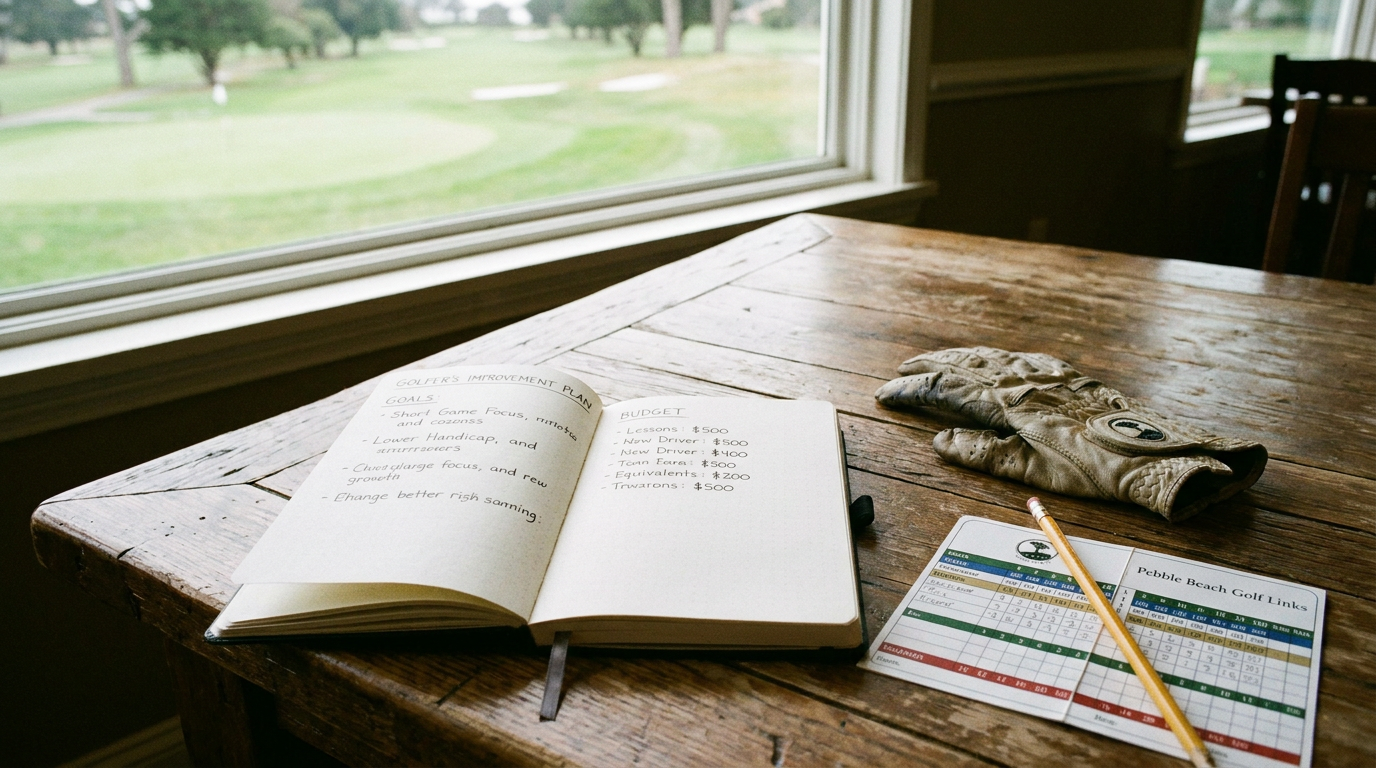
What improvement to expect. Now the harder question — will it work? My honest answer, built on more than two decades of teaching: yes, almost certainly, but the size and speed of the gains depend heavily on where you start.
- Higher-handicap golfers (roughly 20+) improve fastest. There’s low-hanging fruit everywhere — grip, setup, contact, basic course management — and fixing fundamentals can shed strokes in bunches. Seeing five or more strokes come off over a committed lesson series and a season of practice is common and realistic.
- Mid-handicappers (roughly 10–19) grind through the middle. The fundamentals are mostly there; the work shifts to consistency, short game, and eliminating the one or two disaster patterns per round. Gains of two to four strokes over a season of structured work is an honest expectation.
- Single-digit players fight for inches. At that level, a single stroke of improvement represents real, hard-won progress — sharper wedge distance control, one fewer three-putt, slightly tighter dispersion. The work gets more precise, and so do the gains.
For calibration, that same 12-month study of club golfers found committed improvers averaged around 2.8 strokes of handicap improvement over the year. Not fifteen strokes in a weekend, the way a YouTube thumbnail promises — 2.8 real, permanent strokes. And against the national backdrop of golfers gaining 1.9 strokes in twenty-five years on their own, nearly three strokes in one year is a completely different trajectory. That’s the honest scale of what structured instruction does.
But I’d argue strokes aren’t even the whole return. There’s a hidden ROI to lessons that nobody puts on a pricing page. Every range session after a lesson has a purpose, which means you stop paying for buckets of confusion. You make smarter equipment decisions, because you understand your swing well enough to know what you actually need — I’ve saved students the cost of their entire lesson package just by talking them out of a driver that wouldn’t have helped. And most importantly, the game gets fun again. Golfers don’t quit because of one bad round; they quit because of the hopeless feeling that nothing they do matters. A real plan cures that. In my experience, that’s worth more than the strokes.
Of course, “what should I pay and what will I get” depends enormously on which kind of lesson actually fits your life. A junior, a retiree, a beginner, and a weekend warrior shouldn’t be buying the same thing — so let’s find your fit.
Private, Junior, Women’s, and Group Golf Lessons: Finding Your Fit
One of the quiet mistakes golfers make when searching for instruction is assuming a lesson is a lesson. It isn’t. The right format can accelerate everything; the wrong one can waste your money and your season. Over 20-plus years teaching in the Philadelphia area, I’ve worked with every kind of golfer there is — so let me help you find yourself in this list.
Private One-on-One Lessons
This is the gold standard for a reason: every minute is about you. Your swing, your misses, your body, your goals. Private instruction is the fastest path to change, and it’s the right choice for golfers with a specific, persistent fault (that slice you’ve carried for a decade), golfers with concrete goals (breaking 90, breaking 80, making the high school team), and anyone whose schedule demands maximum progress per hour invested. If you take one thing from the vetting section above, apply it here — private lessons are where diagnosis-before-prescription and structured practice plans matter most, because you’re paying for a fully personalized process.
Junior Golf Lessons
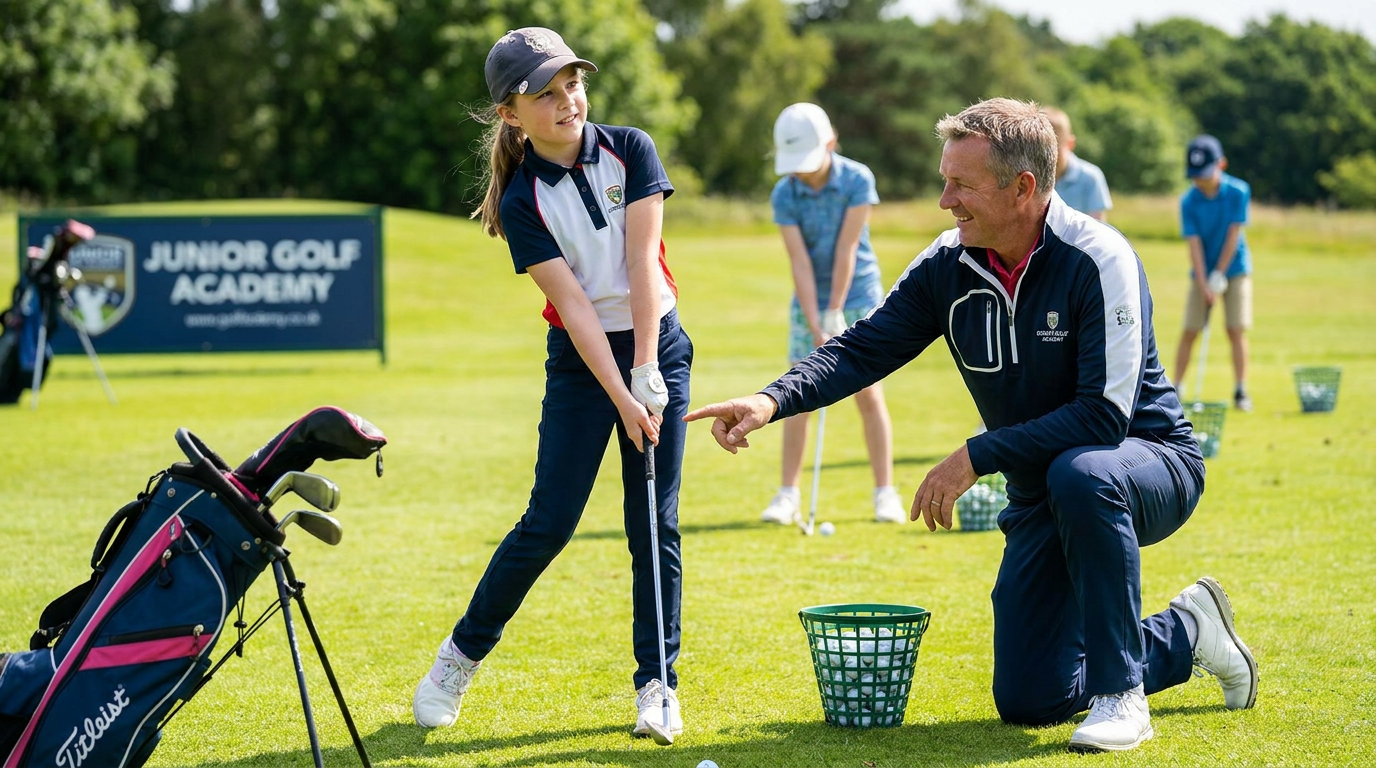
Parents, this section is for you, and I’ll speak plainly because I’ve coached juniors across Montgomery and Bucks County for decades. The most important qualities in a junior instructor are not swing knowledge — they’re patience and age-appropriateness. A 7-year-old should be developing athleticism, contact, and love for the game; forcing tour-style positions on a small, growing body is how you create both bad swings and burned-out kids. What to look for: a coach who talks to your child (not just to you), keeps sessions fun and moving, celebrates process over score, and thinks in years, not weeks. Junior golf done right builds a golfer for life. Done wrong, it builds a kid who quits at thirteen. There is no student I take a longer view with than a junior.
Women’s Lessons and Clinics
Here’s something the Philadelphia region should brag about more: this area has one of the deepest women’s golf traditions in the country. The Women’s Golf Association of Philadelphia is the oldest women’s golf association in the United States — women have been organizing, competing, and building this game in our region for well over a century. Yet I still regularly meet women who hesitated for years before booking a lesson because so much golf instruction culture feels like it wasn’t built with them in mind. The environment matters enormously. Whether it’s private lessons or a women’s clinic, look for an instructor who creates a welcoming, judgment-free setting, fits the instruction to your physical strengths rather than forcing a one-size-fits-all model, and treats questions as the point of the lesson rather than an interruption. The women’s golf community in this region is thriving — the right instruction is your on-ramp into it.
Group Clinics
Don’t let anyone tell you group lessons are the lesser option — they’re a different tool for a different job. Clinics are budget-friendly, they’re social, and for beginners especially, they offer something private lessons can’t: you learn from watching other people’s swings and other people’s fixes. Hearing a coach solve someone else’s slice teaches you about ball flight in a way that pure personal instruction sometimes doesn’t. Clinics are ideal for newcomers who want a low-pressure entry point, couples and friends learning together, and golfers who simply enjoy the energy of a group. Many of my students started in a group setting and graduated to private work once they knew what they wanted to fix.
The Year-Round Advantage (Yes, Even in a Philadelphia Winter)
One more format consideration that’s uniquely important here: the off-season. Most Philadelphia golfers treat November through March as a dead zone, then spend April rebuilding a swing they’d forgotten. That cycle — improve, hibernate, regress, repeat — is why so many local golfers plateau for decades. Indoor and video-supported instruction breaks it. Winter is actually the best time to make meaningful swing changes: no scorecards to protect, no buddies watching, no pressure to perform on Saturday. The golfers who show up in April already ahead are the ones who used the winter, not the ones who waited for it to end.
One last piece of fit advice, whatever format you choose: get an official handicap. Joining the Golf Association of Philadelphia — our region’s amateur golf body — gives you a real, standardized handicap index, which means you can actually measure what your lessons are producing. Remember, the golfers in that improvement study who progressed most were the ones tracking their numbers. A handicap turns “I think I’m getting better” into “I’ve dropped 3.1 strokes since May.” As a bonus, GAP membership connects you to one of the most active amateur golf communities in the country. Lessons give you the improvement; a handicap gives you the proof.
Whichever golfer you recognized yourself as in this section, the path forward looks the same: one first lesson. And since fear of the unknown is the last thing standing between most golfers and that booking, let me eliminate it entirely by showing you exactly what a first lesson with me looks like.
Your First Lesson at DCSJr Golf Academy, Step by Step
Every week, someone tells me some version of the same confession: “I’ve been meaning to book a lesson for two years.” When I ask what stopped them, it’s almost never money or time. It’s not knowing what to expect — the vague dread of being judged, overwhelmed, or handed a rebuild they didn’t ask for. So let me walk you through exactly what happens when you come see me, minute by minute, so there’s nothing left to imagine.
You’ll find me at DCSJr Golf Academy, based at Lower State Road Golf Center, 500 Lower State Rd, North Wales, PA 19454 — an easy drive from Philadelphia, and convenient to just about anywhere in Montgomery County or Bucks County. Here’s how your first hour with me goes:
- We talk before we touch a club. I want to know your golf history, your typical miss, what you’ve already tried, any physical limitations, and — most importantly — what you want from your game. Breaking 100 and making your club championship flight are different destinations, and I don’t pick your destination for you.
- I watch you swing, and we put it on video. No changes yet — just assessment. You’ll hit balls the way you normally do while I capture your swing on camera. Then we’ll look at it together, and for many students this is the most eye-opening five minutes of their golfing lives. What you feel and what’s actually happening are almost never the same thing, and seeing it changes everything.
- We pick one or two priorities. Not ten. This is the heart of my approach. Out of everything I see, I’ll identify the one or two changes that will produce the most improvement — usually the root causes that other flaws are just symptoms of. You will not leave my lesson tee with a head full of fifteen swing thoughts. That’s not teaching; that’s noise.
- You leave with a simple practice plan. Specific drills, specific reps, specific feels — a plan you can execute at the range on your own, so the lesson keeps working all week. Remember what I said earlier: your improvement lives in the hours between lessons, and my job is to make those hours count.
A few practical answers to the questions people are embarrassed to ask: Yes, bring your own clubs if you have them — I want to see the real you — but if you don’t own clubs yet, that’s completely fine and we’ll work with what’s on hand. A full first lesson runs about an hour. And no, there is no such thing as “too much of a beginner.” I have taught people who had never once touched a golf club, and I genuinely enjoy those lessons — no bad habits to undo, just a clean slate and quick wins.
“I meet each golfer exactly where they are. My job isn’t to hand you a lesson — it’s to hand you a path. Quick fixes sell, but development is what actually changes a golfer’s life, and after more than twenty years on the lesson tee, I’ve never once regretted taking the long view with a student.”
That’s my philosophy in one paragraph, and it’s the standard I’d encourage you to hold any instructor to — including me. As a PGA Professional teaching in this area for more than 20 years, I’ve seen every fad, every miracle method, every “one weird move” come and go. What’s never gone out of style is honest diagnosis, one clear priority at a time, and a coach who’s genuinely invested in where your game is going, not just in filling next Tuesday’s slot.
When you’re ready to take that first step, reach out and let’s set up your first lesson — I’ll take it from there. And if you’re not quite ready to book yet, that’s honestly fine too. Improvement starts with information, so join my free golf tips newsletter and you’ll get practical instruction from a PGA Pro in your inbox — no commitment, no pressure. You can also browse the Insights blog, where I regularly publish the same kind of straight-talking instruction content you’ve been reading here.
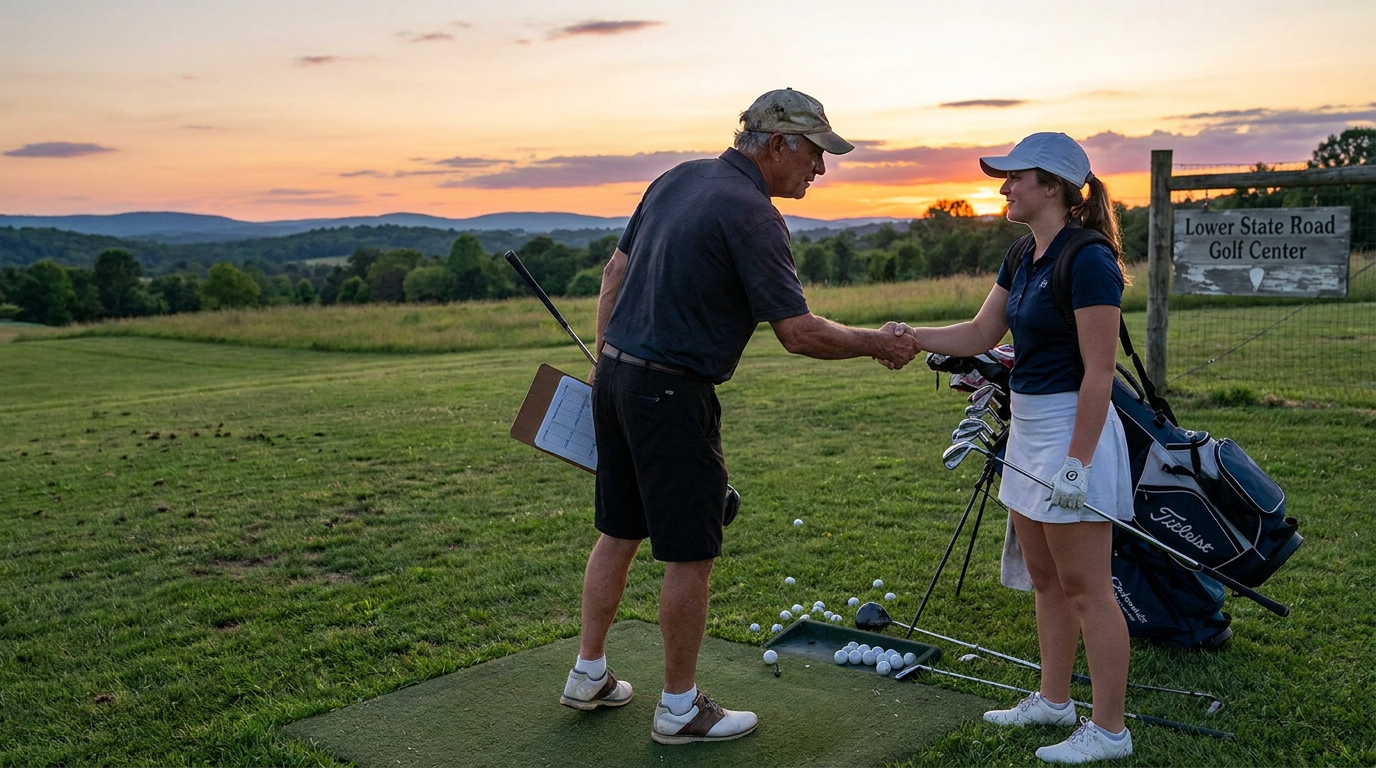
However you take the first step — a booked lesson, a newsletter signup, or just a smarter search — you now have something most golfers never get: a real framework for the decision. Let me leave you with it in its simplest form.
The Real Answer to Your Search for Golf Lessons in Philadelphia
Strip away the four thousand words, and the framework fits in your pocket: verify the PGA credential through the official directory, ask the seven vetting questions before you book, expect to invest roughly $50–$150 per hour with realistic improvement of a few strokes over a committed season, and choose the lesson format — private, junior, women’s, or group — that actually fits your life instead of someone else’s template. Do those four things and you will not choose badly. I’ve watched golfers navigate this decision for over two decades, and the ones who follow that framework end up with a coach they trust and a game that finally moves.
But here’s the reframe I hope stays with you longest. You searched for golf lessons in Philadelphia — but that’s not really what you’re looking for. What you’re looking for is a coach who’s invested in your game. Someone who sees your swing as a puzzle worth solving, your goals as worth taking seriously, and your improvement as a shared project rather than a transaction. The directories can’t list that. The star ratings can’t measure it. But now you know exactly how to find it.
After more than 20 years of teaching this game, I can tell you the one thing I believe more deeply now than the day I earned my PGA membership: every golfer can improve. Every single one. Not with a miracle tip, not overnight — but with the right guidance, an honest plan, and a coach who meets them where they are. I’ve seen it in 7-year-olds and 77-year-olds, in beginners and club champions, in golfers who’d given up on themselves years before they walked onto my tee.
Your best golf season starts with one conversation. I teach at Lower State Road Golf Center in North Wales, PA — a short drive from anywhere in the Philadelphia area. If you’re ready, book your first lesson with me here, or take a look at my lesson rates and monthly programs if you’d like the numbers first. And if you’re still in research mode, join the free newsletter and let me start proving my value to you one tip at a time.
Let’s build your game together.
— David C. Smith Jr., PGA Professional, DCSJr Golf Academy