
If I had a dollar for every time a woman called to book her first lesson and said some version of “I just don’t want to embarrass myself,” I could probably retire to a beach somewhere and never teach another grip again. I’m glad I can’t, because teaching golf — especially teaching golf lessons for women who are brand new to the game — is the best part of my job, and it has been for more than twenty years.
My name is David C. Smith Jr. I’m a PGA Professional, and I teach out of North Wales, Pennsylvania, working with students from Montgomery County, Bucks County, and all over the greater Philadelphia area. A big part of my teaching life is our dedicated women’s golf program, which means I’ve had this exact conversation — the nervous phone call, the hesitant email, the “my husband bought me this lesson and I’m terrified” walk-up — hundreds of times. And I can tell you with complete confidence: the fear is almost always bigger than the reality. Usually by a mile.
So this article is my attempt to answer, honestly and all in one place, every question I hear from women thinking about starting golf. Where do I start? What will it cost? Do I need my own clubs? Will I be the only beginner there? Is it too late for me? We’ll walk through why women-specific instruction genuinely works better, what actually happens in your first lesson, what gear you need (and what you absolutely don’t), a realistic 90-day learning timeline, and the surprisingly wonderful women’s golf community here in Philadelphia. No sales pitch. No sugarcoating. Just the roadmap I wish someone handed every one of my students before their first lesson.
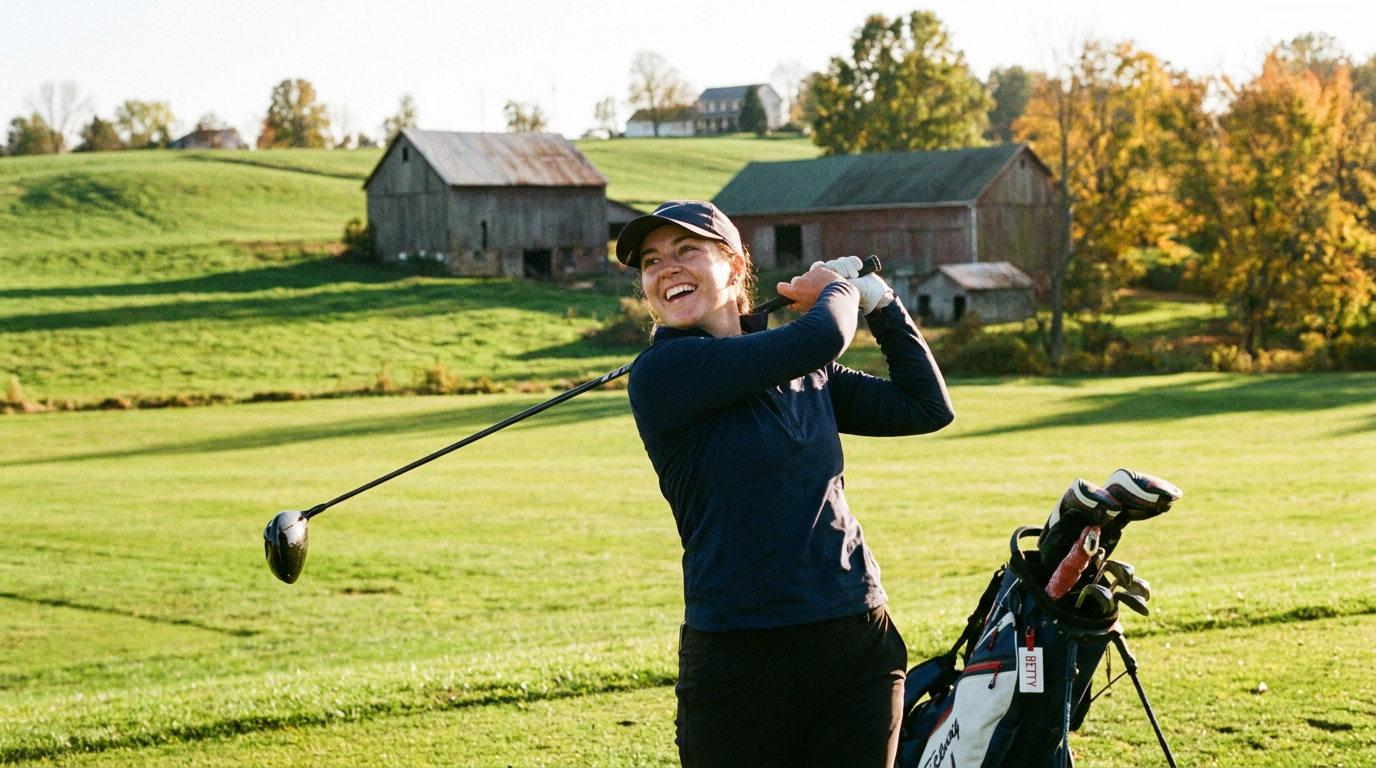
Why Golf Lessons for Women Are Worth It — And Why Now
Let’s deal with the elephant on the tee box first: the quiet suspicion that golf “isn’t for you.” Maybe it’s the country-club stereotypes. Maybe it’s a memory of some course ranger barking at you fifteen years ago. Maybe it’s just that every golf commercial you’ve ever seen features a guy in a visor. Whatever planted the seed, I want to pull it out by the roots, because the numbers — and everything I see on my lesson tee every single week — tell a completely different story.
Women are taking up golf right now at a pace this game has genuinely never seen. According to the National Golf Foundation, more than 8.1 million women and girls played on-course golf in the United States in 2025 — an all-time record — and the number of female golfers has grown roughly 45% since 2020. Even more telling: women now make up about 35% of all beginning golfers, and women and girls have accounted for the majority of golf’s net participation growth over the last five years. Read that again. The fastest-growing group in golf isn’t retired executives. It’s women picking up a club for the first time. If you start this year, you’re not the odd one out — you’re part of the biggest wave of new golfers in the sport.
The industry has noticed, and it’s built real infrastructure around this growth. The LPGA created LPGA Golf 101, an entire “Welcome to Golf” ecosystem designed by women, for women, specifically to make those first steps friendlier. The PGA of America publishes its own guide for adult women starting golf, and its core recommendation matches exactly what I’ve watched work for two decades: start with a coach, in a supportive environment, ideally alongside other women learning at the same time. You are not walking into a boys’ club anymore. You’re walking into a game that is actively, enthusiastically rolling out the welcome mat.
What Makes Ladies Golf Lessons Different From a Generic Clinic
Here’s the honest answer, from someone who teaches everybody — men, women, juniors, seniors, scratch players, and people who have never touched a club: a well-designed women’s program isn’t a watered-down version of “regular” lessons. It’s a better-fitted version, in a few specific ways.
- Pacing built around learning, not ego. In mixed beginner clinics, I’ve watched new golfers — men and women alike — swing way too hard, way too early, because nobody wants to look tentative in front of strangers. In ladies golf lessons, that arms race mostly disappears. We slow down, build the swing in the right order, and the results come faster. Ironically, the “slower” group almost always progresses quicker.
- Instruction that fits your body, not a template. Strength and flexibility profiles differ from student to student, and good coaching accounts for that. A swing built around rotation, rhythm, and leverage will beat a swing built on raw muscle every time — and frankly, many of my female students develop better tempo faster than my male students because they’re not trying to kill the ball.
- Equipment guidance that actually applies to you. Women’s clubs differ in shaft flex, weight, grip size, and length. A generic clinic hands you whatever’s in the barrel. A women’s program makes sure the tool matches the hand holding it — which matters more for beginners than almost anything else.
- An environment where every question is welcome. This is the big one. When students feel safe asking “basic” questions, they learn dramatically faster. More on my “no stupid questions” policy in a minute — it’s practically a religion at DCSJr Golf Academy.
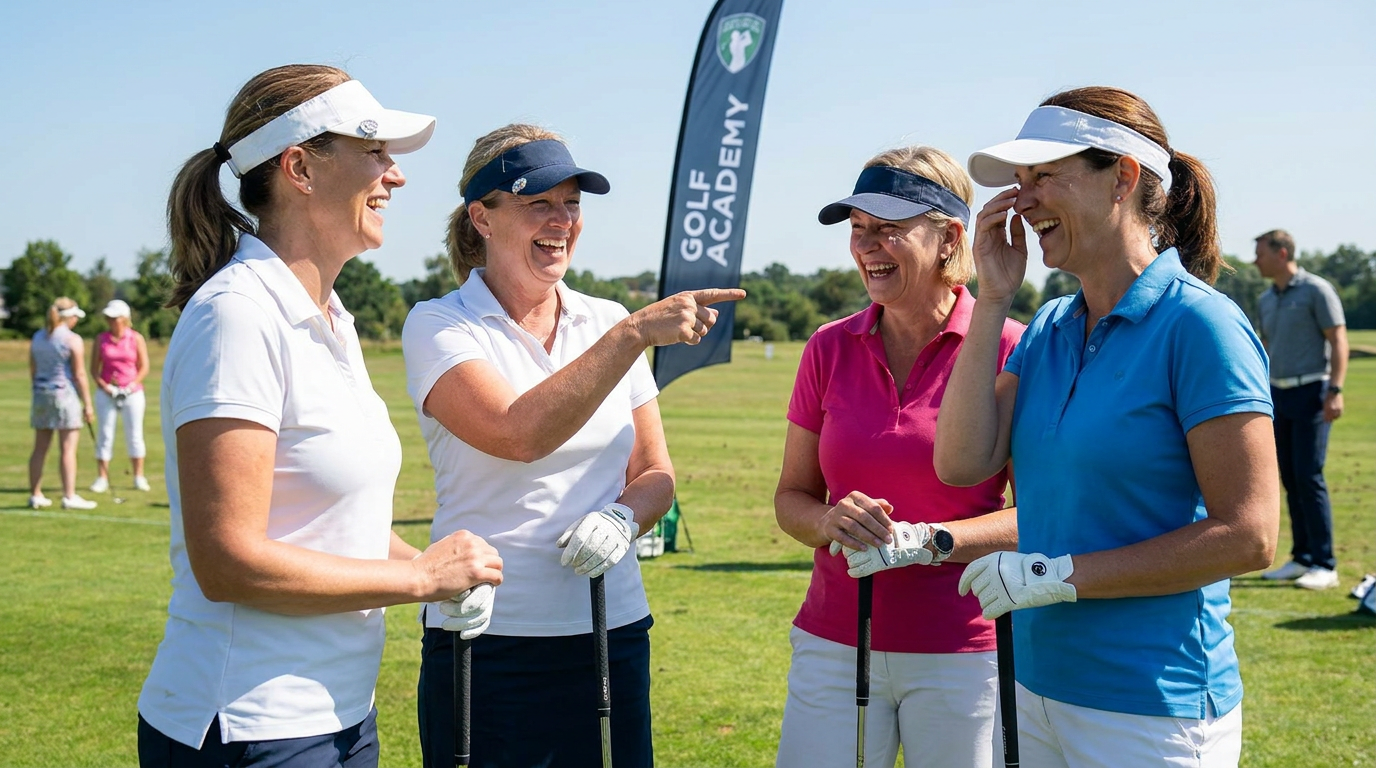
After twenty-plus years of teaching, I can tell you what almost every one of my new female students worries about on day one: looking foolish, holding others up, and being “the only one who doesn’t know anything.” And I can tell you how long those worries typically last: about fifteen minutes. Once the first few balls are in the air — and they get in the air sooner than anyone expects — the whole emotional weather changes. The shoulders drop. The questions start flowing. Somebody laughs at a shank (usually me, at my own demo shot). It becomes, of all things, fun.
“The hardest swing in golf isn’t the driver. It’s the door swing into the pro shop the first time. Once you’ve made that one, everything else is easier.” — David C. Smith Jr., PGA Professional
Philadelphia, by the way, makes all of this easier than most places in the country. Our region has one of the oldest and most active women’s golf communities in America — leagues, associations, and social golf networks that have been welcoming new players for over a century. We’ll map all of that out later in this article, because finding your people is half the game.
But first, let’s tackle the scariest part of any new pursuit: the unknown. Here’s exactly — minute by minute — what happens when you book that first lesson.
Your First Women’s Golf Lesson in North Wales, PA: What Actually Happens
The single biggest barrier between a curious woman and her first golf lesson isn’t money, time, or ability. It’s uncertainty. When you don’t know what’s going to happen, your imagination fills in the blanks — and imaginations are dramatic. So let me take the mystery out of it entirely. Here’s what your first hour of women’s golf lessons in North Wales, PA with me actually looks like.
The First Ten Minutes: A Conversation, Not a Test
You arrive. We shake hands. And then we… talk. That’s it. No swing evaluation, no fitness assessment, no pop quiz on the rules of golf. I want to know why you’re here, because your “why” shapes everything we do together. Some of my students want to play social golf with friends. Some have a spouse or partner who plays and they’re tired of being left home on Saturday mornings. Some are here for business — golf remains one of the great professional networking arenas, and more women are claiming their seat at that table every year. Some just want a new outdoor hobby that they can play for the next forty years. Every one of those goals is legitimate, and every one leads to a slightly different plan.
If you’re curious who you’d be spending that hour with, you can read a bit about me and my background here before you ever pick up the phone. Meeting your instructor — even virtually — takes a lot of the edge off.
The Middle Thirty Minutes: A Few Easy Swings, Zero Judgment
Next, I’ll hand you a club (yes, I provide the club — hold that thought) and ask you to make a few relaxed swings so I can watch. Not judge. Watch. There is nothing you can do in those first swings that I haven’t seen a thousand times, and I promise you there is nothing you can do that will make me think less of you. Whiff it entirely? Happens constantly, means nothing. Top it along the ground? That’s most people’s first shot. Send one accidentally sideways? Congratulations, you’ve officially joined the club — the whole club, all of us, every golfer who’s ever lived.
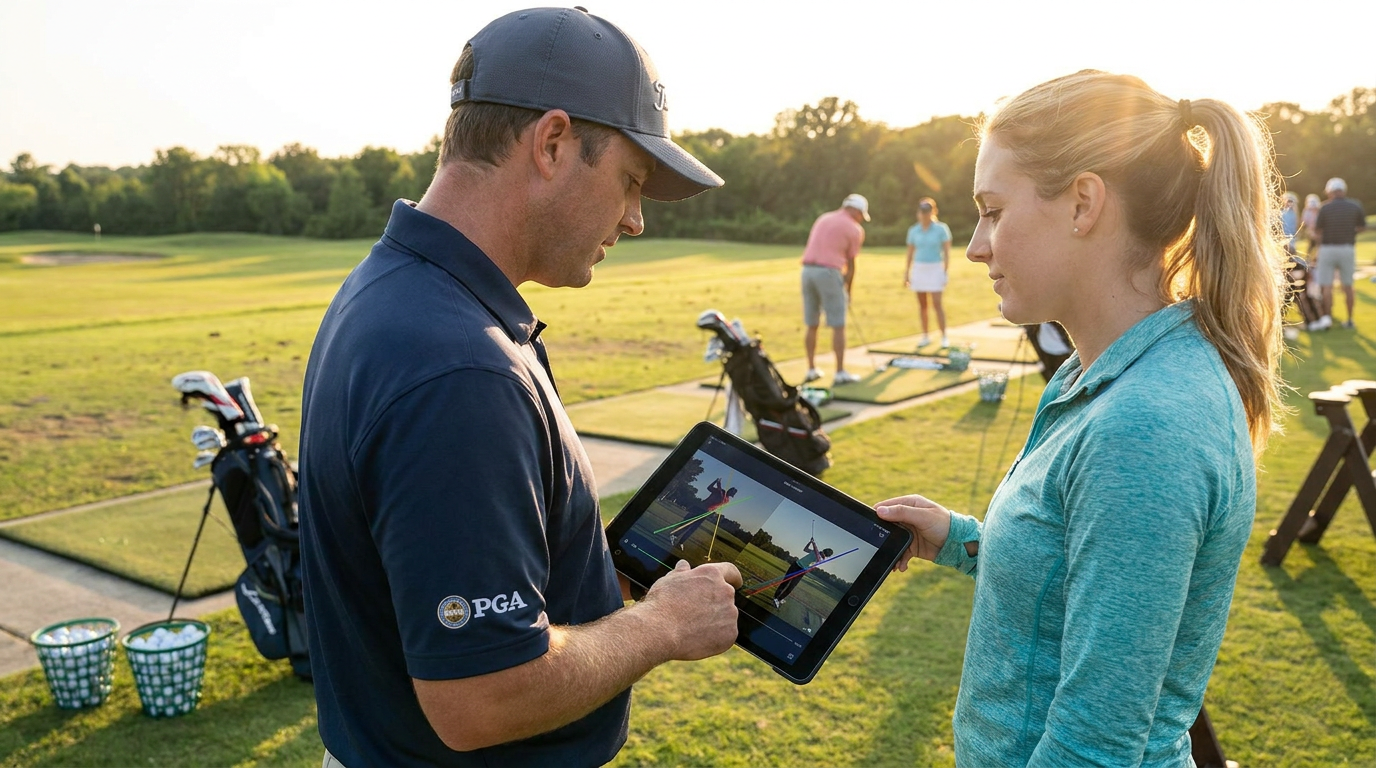
What I’m looking for in those swings is your natural movement — your rhythm, your athletic instincts, how your body wants to turn. Modern coaching doesn’t bulldoze what you naturally do; it builds on it. And this is where technology earns its keep: I use video instruction and swing analysis with nearly all of my students, because seeing your own swing on a screen replaces guesswork with clarity. Most beginners have no idea what their body is actually doing mid-swing — how could you? When you watch yourself in slow motion and I can point to one specific thing and say, “see that? that’s the piece we’re going to work on,” learning accelerates dramatically. It’s the difference between someone describing a photo to you and actually looking at the photo.
The Final Twenty Minutes: One or Two Things — Never Ten
Here’s a promise I make every new student: you will leave your first lesson with one or two clear, simple focus points. Not ten. Not a rebuilt swing. Not a homework packet. Golf instruction fails most often not because coaches don’t know enough, but because they say too much. My job in lesson one is to find the one or two adjustments that will give you the most improvement for the least mental clutter, hand them to you clearly, and send you off feeling like this is doable. Because it is.
What You Need to Bring (Spoiler: Almost Nothing)
This is the most common pre-booking question I get, so let me be as explicit as possible. For your first lesson, you do not need:
- Your own golf clubs. I have clubs for you to use, including women’s clubs. Please do not buy clubs before your first lesson — I’ll explain exactly why in the next section, and it might save you several hundred dollars.
- Golf shoes. Regular sneakers are perfectly fine.
- Golf clothes. Comfortable athletic wear — leggings, shorts, a t-shirt, whatever you’d wear for a walk or a workout — is all you need at the practice facility.
- Any prior experience. None. Zero. “I have literally never touched a golf club” is a sentence I hear weekly, and it’s a perfectly good starting point.
- Knowledge of the rules. You don’t need to know what a birdie is, what “par” means, or which end of the club matters. (Yes, someone once asked me that, half-joking, and it led to one of the best first lessons I’ve ever taught — because she’d given herself permission to know nothing, which meant she absorbed everything.)
So what do you bring? Yourself. Maybe a water bottle. That’s the whole checklist.
The “No Stupid Questions” Policy Is Not a Slogan
Real questions I’ve been asked by beginners over the years: What’s a tee time, exactly? Do I have to be quiet the whole time? Can I pick the ball up if I’m having a bad hole? Why are there different clubs at all? What do I do with the flag? I love every one of these questions, and I mean that sincerely — because every question asked is a piece of anxiety removed, and anxiety is the real enemy of a golf swing. A student who’s comfortable asking anything is a student who learns at double speed. That’s not a philosophy I picked up from a book; it’s twenty years of pattern recognition on the lesson tee.
By the end of hour one, here’s where my typical beginner stands: she’s hit real golf balls, several of them airborne; she understands one or two simple things about her own swing; she’s laughed at least a few times; and — this is the part I never get tired of — she’s usually asking when she can come back. The unknown is gone. What’s left is a game.
Of course, the next honest question after “what happens in a lesson?” is “what’s this all going to cost me?” So let’s talk about money and gear — with real candor, because this is where most beginner guides get cagey and I refuse to.
Golf Clubs, Gear, and Budget: What Beginners Actually Need
I’m going to open this section by talking you out of spending money, which is admittedly a strange move for a guy who sells golf lessons. But the “honest roadmap” promise means telling you the truth about gear, and the truth is this: the biggest financial mistake new golfers make is buying a full set of clubs before their first lesson.
Here’s why. Clubs are fitted to a swing — grip size to your hands, shaft flex to your swing speed, club length to your posture and build, set composition to your actual needs on the course. Before your first lesson, you don’t have a swing yet. Buying clubs at that stage is like buying prescription glasses before your eye exam. The shiny boxed set from the sporting goods store might fit you fine… or it might fight you on every single swing, and you’ll never know which flaws are yours and which belong to the equipment. I’ve watched too many students spend months struggling against clubs that were never right for them. Wait. Please. The clubs will still be there.
The Three-Phase Gear Roadmap
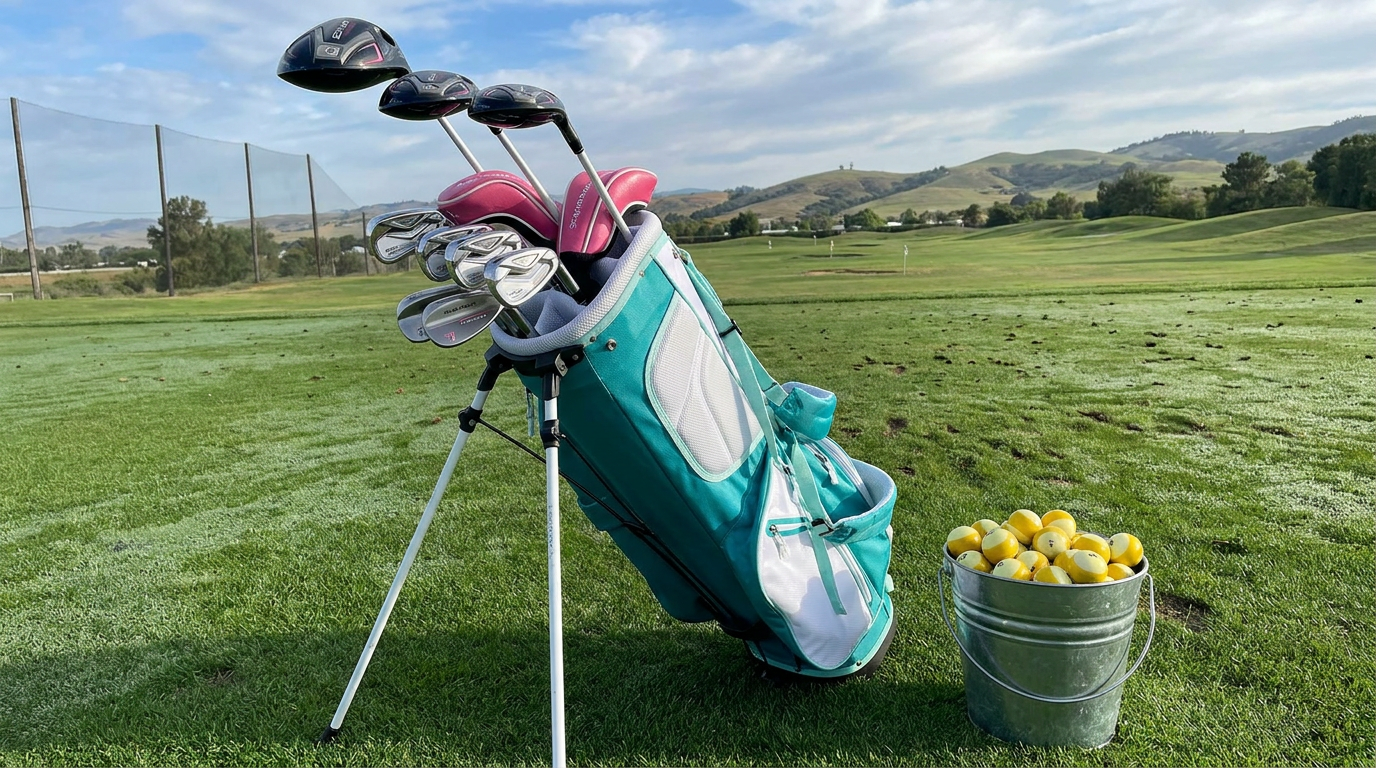
Instead of one big purchase, think of golf gear in three phases that match your actual development:
- Phase 1 — Lessons with loaner clubs (Months 0–2). Use my clubs, or borrowed ones, while you build your fundamentals. Total gear investment: essentially zero. A glove if you’d like one (roughly $15–25) to prevent blisters, and that’s it.
- Phase 2 — A starter or half set (Months 2–6). Once your swing fundamentals have taken shape, a half set — driver or fairway wood, a hybrid, a few irons, a wedge, and a putter — is genuinely all a beginner needs. A quality used or entry-level women’s starter set covers this beautifully, and I can point you toward options that fit your swing by then. Carrying seven clubs instead of fourteen also makes your first on-course rounds simpler and lighter, which matters more than people realize.
- Phase 3 — Fitted clubs (When you’re playing regularly). When golf has become part of your life — you’re playing regularly, you’ve got a repeatable swing, and you know you’re in this for the long haul — that’s the moment for a proper club fitting and a set built for you. By then, your swing has stabilized enough that a fitting actually means something, and every dollar you spend buys real performance.
Quick shorthand version — buy now: a glove and sunscreen; buy later: a starter half set, golf shoes, and a bag; skip entirely (for now): the $600 driver, the rangefinder, the fourteen-club tour bag, and anything the salesperson calls “game improvement technology” before you have a game to improve.
What Do Beginner Golf Lessons Near Me Actually Cost?
Let’s talk lesson pricing plainly, because if you’ve been searching “beginner golf lessons near me” and finding pages that hide their rates, I understand the frustration. At DCSJr Golf Academy, I offer individual lessons in both full-hour and 45-minute formats, along with lesson packages and monthly program structures for students who want a sustained development plan — private and group options serving Montgomery County, Bucks County, and the greater Philadelphia area. Rather than print numbers here that may shift over time, I keep everything current on our lesson rates and programs page — no phone call required to find out what things cost, because I think you should be able to budget before you ever talk to me.
Here’s the honest framing I’d offer on cost, though: compare the price of a handful of lessons now against the alternative, which is years of self-taught frustration. Golf is famously unkind to guessers. The habits you build in your first three months tend to stick for decades — good ones and bad ones. Students who come to me after five years of YouTube-and-guesswork golf routinely need more lessons to undo their habits than a true beginner needs to build correct ones from scratch. Starting with instruction isn’t the expensive path. It’s the cheap one, amortized honestly.
The Rest of Golf Is Cheaper Than You Think
One more myth worth flattening: that golf for beginners — women or anyone else — requires a country club budget. It doesn’t. A bucket of balls at a driving range in our area typically costs less than lunch. The greater Philadelphia region is full of public courses, par-3 layouts, and executive courses that genuinely welcome beginners, with green fees that would surprise you. Used club sets are abundant and perfectly good for your entire first year. Twilight rates make evening golf one of the most affordable recreational hours you can buy. Yes, golf can be expensive — anything can, if you chase the top shelf — but a smart beginner in this area can go from first lesson to first full round for less than the cost of a decent road bike, and considerably less than a season of many other hobbies.
So the money question has an honest answer: less than you feared, spent in a smarter order than you’d have guessed. Which brings us to the question underneath all the others — the one every student eventually asks with a slightly nervous laugh: okay, but how long until I can actually play?
Golf for Beginners: Your Realistic First 90 Days, Women’s Edition
I’m going to give you a real timeline now, and I want to be careful with it — because timelines can inspire or discourage depending on how honestly they’re framed. So here’s the frame: this is what a typical, committed beginner’s first 90 days look like. Yours might run faster or slower, and both outcomes are normal. Golf is not a race. But humans do better with maps than with fog, so here’s the map.
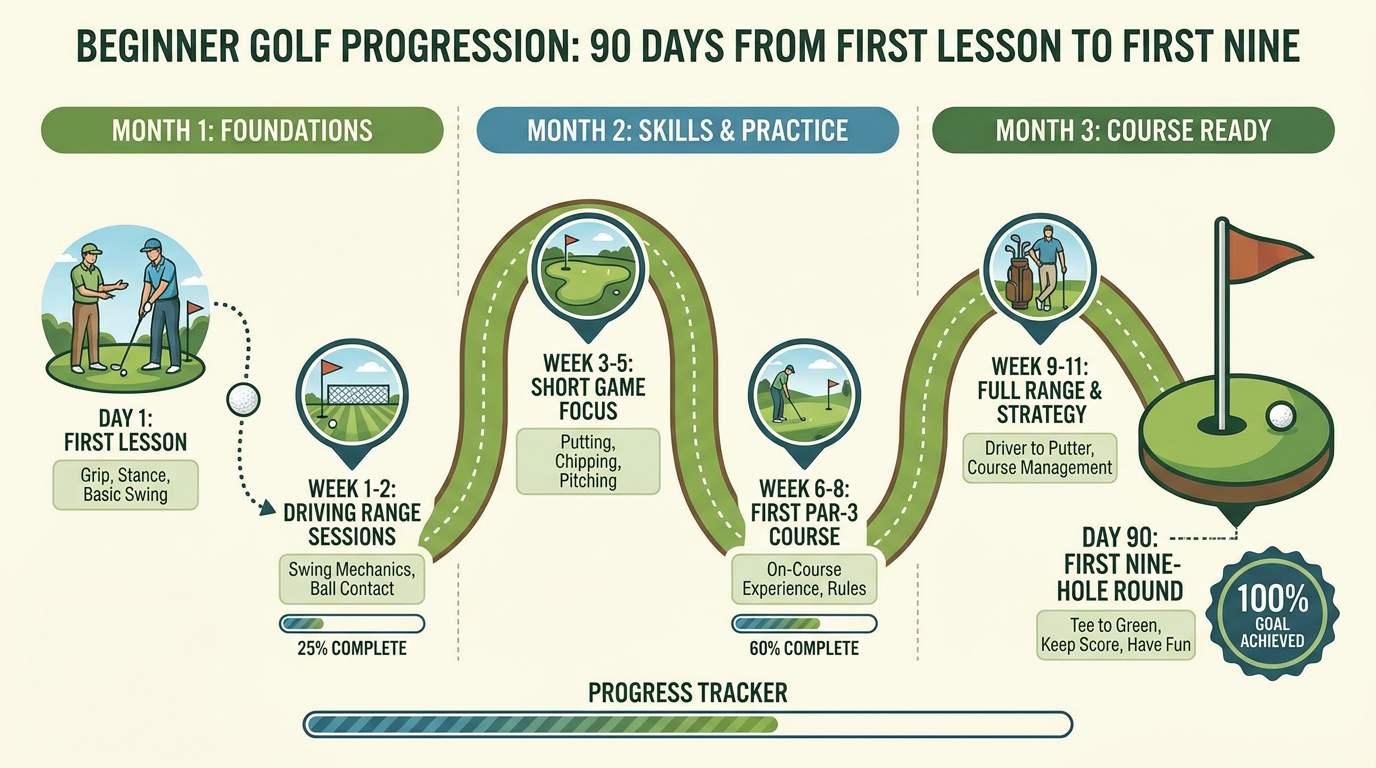
Month One: Fundamentals — Grip, Setup, and Contact
The first month is about three things: how you hold the club, how you stand to the ball, and making solid contact. That’s it. It sounds almost insultingly simple, and it’s the foundation of everything you will ever do in golf. Weekly or biweekly lessons, plus one or two short range sessions on your own in between, is the ideal rhythm. By the end of month one, most of my students are getting the ball airborne with reasonable consistency — and I’d encourage you to remember your very first airborne shot, because there’s a specific feeling to it, a little jolt of oh, THAT’S what it’s supposed to feel like, that hooks more people on this game than any commercial ever has.
Month Two: The Short Game — Where Beginners Win Fastest
Month two, we add chipping and putting, and here’s a coaching secret worth the price of this free article: the short game is where beginners find confidence fastest. Roughly half the shots in any round of golf happen within 50 yards of the hole, and those shots require finesse, not power — which means a two-month beginner can genuinely hold her own around the greens against players with years of experience. Putting rewards touch, patience, and calm, and I have watched brand-new students out-putt their veteran husbands within weeks. (I have also watched them enjoy this immensely. I say nothing. I just smile.)
Month two is also where consistency starts forming — where your good shots stop feeling like accidents and start feeling like something you did on purpose. That shift, from luck to intention, is the real graduation.
Month Three: Your First Time on an Actual Course
Month three is the payoff: your first on-course outing, ideally at a par-3 or executive course, where holes are shorter and the atmosphere is relaxed. We cover basic etiquette and pace of play beforehand — where to stand, when to be still, how to keep things moving — and I want to demystify this too, because “etiquette” scares new golfers far more than it should. It’s not a secret aristocratic code. It’s about 90% ordinary consideration: don’t talk during someone’s swing, be ready when it’s your turn, fix the marks you make. If you can handle a dinner party, you can handle golf etiquette. And here’s a beginner’s cheat code that veterans wish someone had told them: picking up your ball when a hole has gotten away from you is not cheating — it’s good pace-of-play manners. Nobody’s counting. You’re allowed to just… move on. Golfers who learn this early enjoy the game about twice as much.
The Honest Part: Progress Is Not a Straight Line
Now, the part of the timeline that no glossy beginner’s guide will tell you, and the part I consider the emotional core of learning this game: progress is not linear. Some weeks everything clicks and you’ll wonder why anyone finds this hard. Other weeks, a swing that felt automatic on Tuesday vanishes by Saturday, and you’ll wonder if you dreamed the whole thing. This is not a sign you’re “not athletic enough.” It’s not a sign of anything, except that you’re a human being acquiring a complex motor skill — which is inherently a cycle, not a staircase.
I’ve written in depth about this on my blog — Performance vs. Learning in Golf Practice — but the short version is this: practice is a loop of learning (absorbing something new, which usually makes you temporarily worse), testing (trying it under mild pressure), and performing (letting it run without thinking). Beginners who expect a straight line from lesson to lower scores get discouraged by the dips. Beginners who understand the loop see those same dips for what they are: evidence of learning in progress. The dip isn’t failure. The dip is the tuition.
What a Productive 30-Minute Range Session Looks Like
Between lessons, quality beats quantity every time. Here’s the 30-minute session I prescribe for beginners — and note what’s not in it:
- 5 minutes: Easy half-swings with a short iron. No target, no judgment. You’re waking up the motion, not testing it.
- 15 minutes: Your current focus point — the one or two things from your last lesson — with a specific target on every single shot. Slow, deliberate, one ball at a time. Step away between shots.
- 10 minutes: Chipping or putting. Every visit. No exceptions. This is where your scores will live.
What’s missing? The driver — or at least, the 45 minutes of exhausted, frustrated driver-bashing that fills every range in America. Mindlessly hammering drivers is entertainment, not practice, and it usually reinforces exactly the habits we’re trying to replace. Thirty focused minutes twice a week beats two aimless hours on Saturday, every time. For extra material between lessons, the LPGA’s instruction resources offer excellent drills and tips from LPGA professionals — a great supplement (though I’ll gently note: a supplement to coaching, not a substitute for it).
Milestones Worth Celebrating (None of Which Are Scores)
Golf culture is obsessed with scores, and I’d like to formally excuse you from that obsession for your entire first year. Here are the milestones that actually matter for a beginner, in roughly the order they arrive: your first airborne shot. Your first shot that goes where you aimed it. Your first completed hole. Your first sand escape (there will be sand; there is always sand). Your first nine holes with friends. And my personal favorite — the milestone I watch for with every student — the first round where you stop apologizing. No more “sorry” after every mishit, no more “I’m so bad at this” as a reflex. Just a person, outdoors, playing a game. When the apologies stop, the golfer has arrived. Everything after that is refinement.
Ninety days. That’s the honest distance between “I’ve never touched a club” and “I played nine holes with my friends on Sunday and I’m annoyed we only had time for nine.” But the swing is only half the journey. The other half is people — and this is where living in the Philadelphia area turns out to be a genuine, borderline-unfair advantage.
Women’s Golf in Philadelphia: You Won’t Be Playing Alone
Here’s something I tell every new student, and I mean it as literally as I can say it: you happen to be learning golf in one of the best regions in the United States to be a new woman golfer. That’s not local boosterism. Philadelphia’s women’s golf infrastructure is old, deep, organized, and — crucially for you — genuinely welcoming to beginners. Let me map it out.
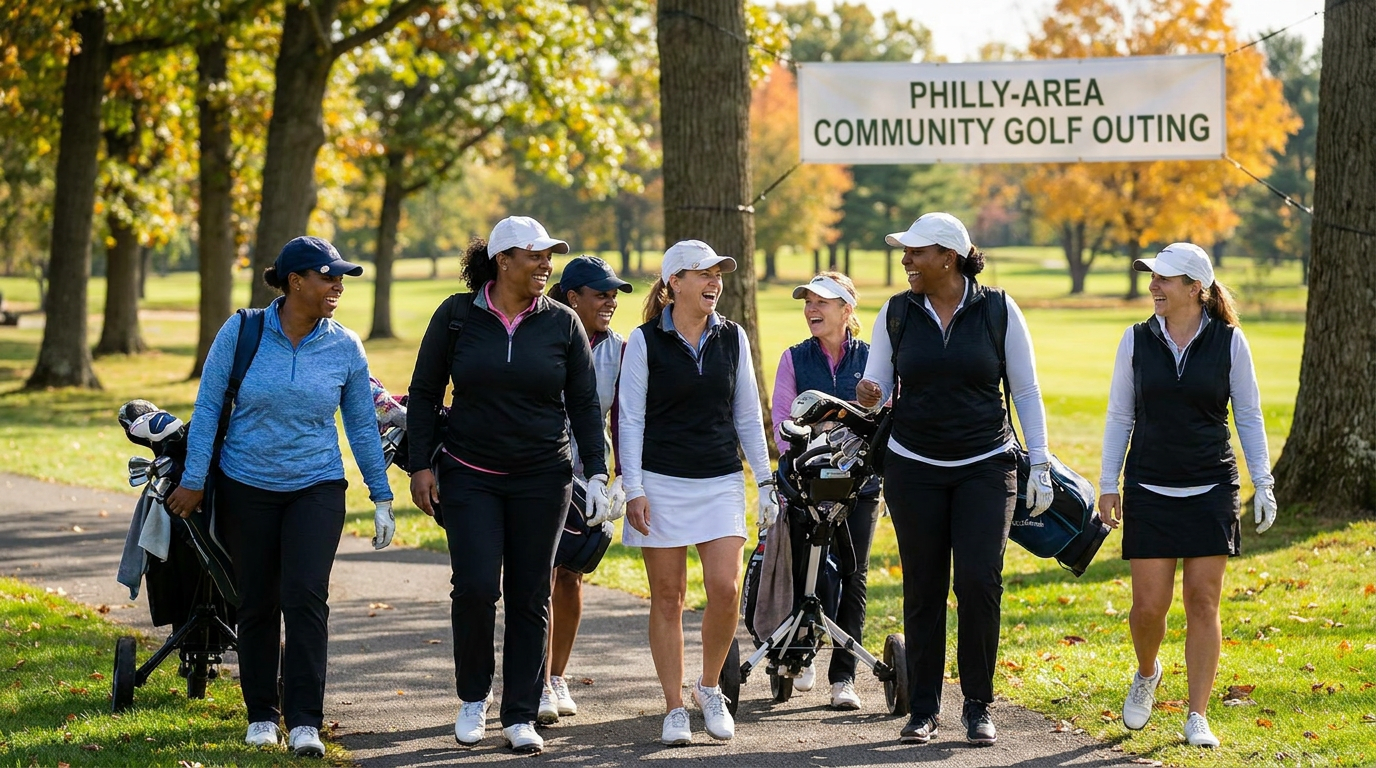
Women on Course — Philadelphia: Golf as a Social Life
If formal lessons build your swing, Women on Course – Philadelphia builds your golf life. This is an active local chapter of a national community designed around exactly the reader of this article: women who want to connect, learn, and play in a low-pressure, high-fun environment. The Philadelphia chapter hosts beginner-friendly clinics, social gatherings, networking events, on-course play days, and even golf getaways. What makes it special is the explicit understanding that golf, for many women, is a social and professional vehicle first — a way to build friendships and business relationships — with the scorecard a distant afterthought. You can show up to a Women on Course event as a total beginner and be welcomed, not tolerated. That distinction matters enormously in your first year, and it’s why I recommend the group to my students constantly. Lessons and community aren’t competing paths. They’re the two legs you walk on.
The Women’s Golf Association of Philadelphia: A Century of Precedent
For a sense of how deep this region’s women’s golf tradition runs, look at the Women’s Golf Association of Philadelphia — one of the country’s storied women’s amateur golf organizations, promoting and nurturing women’s competitive and recreational golf across the region for generations. You don’t need to be anywhere near competitive golf for WGAP to matter to you. Its significance for a beginner is symbolic and practical at once: women’s golf in Philadelphia isn’t a recent accommodation or a marketing trend. It’s a tradition, with over a century of women organizing, competing, and building the game here. When you take up golf in this area, you’re not knocking on a closed door. You’re joining a lineage. There’s something quietly powerful about that, and my students feel it.
Women’s Golf Day and the June Effect
Circle June on your calendar. Every year, Women’s Golf Day anchors a global celebration of women and girls playing golf, with events at courses and facilities around the world — including plenty right here in the Philadelphia area — designed specifically to welcome newcomers. June doubles as Women’s Golf Month, which means the entire industry spends those weeks rolling out beginner clinics, open houses, and welcome events. If you’re reading this in the spring of 2027 or beyond and wondering when to start: June is the single easiest on-ramp of the year, when every facility in the region is actively looking for you. (And if you’re reading this in November — start anyway; indoor and off-season instruction is one of golf’s best-kept secrets, and you’ll walk onto the course in April ahead of everyone who waited.)
Why Lessons Plus Community Is the Formula That Sticks
Now, the coaching observation that ties this whole section together. After twenty-plus years, I can predict with unsettling accuracy which of my students will still be playing golf in five years. It’s not the most athletic ones. It’s not the ones with the prettiest swings. It’s the ones who found a group. The students who join a league, plug into Women on Course, or simply assemble a regular foursome of friends stick with golf at dramatically higher rates than students who only ever practice alone. This shouldn’t surprise anyone — golf is, at its heart, a social sport, a four-hour walk with people you like, occasionally interrupted by a golf shot. The fastest way to love this game is to play it with people cheering for you. The national data backs this up too: the organizations driving women’s record participation growth all emphasize community as the retention engine, not just instruction.
So here’s your practical three-step plug-in plan for the women’s golf Philadelphia scene:
- Attend one Women on Course – Philadelphia event. Just one. Go as an observer, a networker, a curious beginner — no swing required.
- Book a lesson block for your fundamentals. Community gives you the reason to play; lessons give you the ability to enjoy it.
- Put a Women’s Golf Day event on your June calendar. Consider it your annual holiday now. You’re a golfer. Golfers get holidays.
The community is here. The instruction infrastructure is here. Which leaves exactly one decision on your roadmap: choosing the person who’s going to teach you. Let me help you make that choice well — even if the coach you choose isn’t me.
How to Choose a Golf Instructor: A Beginner’s Buying Guide
I’m going to give you genuinely neutral advice in this section, because I’d rather you find the right instructor than simply find me. A bad fit between student and coach sours people on golf, and I hate losing golfers more than I hate losing students. So here’s how to evaluate any golf instructor in the Philadelphia area — or anywhere.
Five Things to Look For in Any Golf Coach
- PGA certification. This is the baseline. A PGA Professional has been formally trained and tested in instruction, not just in playing. Plenty of great players are mediocre teachers; certification at least guarantees your coach studied teaching.
- Real experience with women and true beginners. Ask directly: “How much of your teaching is with beginner women?” A coach who mostly polishes single-digit handicaps may be brilliant and still wrong for you. Beginners need a different skill set — patience, sequencing, and the ability to simplify — and a dedicated women’s program is a strong signal the coach has built that muscle.
- A philosophy of learning over quick fixes. Beware the coach who promises to “fix your slice in one lesson.” Golf improvement is a learning process, not a repair job, and coaches who understand the difference build golfers who last. Ask a prospective instructor how they think about practice between lessons; the quality of that answer tells you almost everything. (If you want to sample how I think about it, my ongoing Insights blog is all there in the open — I’d encourage you to read any instructor’s writing or reviews the same way.)
- Modern tools, used sensibly. Video analysis and swing technology accelerate learning enormously — but the technology should serve the teaching, not replace it. A tablet full of squiggly lines means nothing without a coach who can translate it into one simple thought you can use.
- Comfort. Above everything else, comfort. You should feel completely at ease asking this person anything. If a trial lesson leaves you feeling judged, rushed, or talked down to, keep looking — no credential outweighs that feeling. The student-coach relationship runs on trust, and trust is the actual product you’re buying.
And three questions worth asking before you book with anyone: Do you offer a dedicated women’s program? How do you structure lessons for a total beginner? What am I supposed to do between lessons? Any instructor worth your money will have crisp, confident answers to all three.
Honest Answers to the Questions Every Beginner Asks
How many lessons does a beginner woman need?
Most of my beginning students build solid fundamentals in five to eight lessons spread over two to three months, paired with short practice sessions in between. Some need fewer, some prefer ongoing coaching for the first year — it depends on your goals and how often you can practice. What I’d steer you away from is the one-lesson-and-done approach; a single lesson starts the process but can’t cement it, which is exactly why searching “beginner golf lessons near me” should really mean searching for a beginner program, not a single appointment.
Am I too old to start golf?
No — and I don’t say that to be polite. I have taught first-timers in their sixties and seventies who became genuinely capable, joyful golfers. Golf is one of the very few sports where you can start at 60 and play for 30 more years. The swing we build adapts to your body, whatever its age. The only students who are “too old” are the ones who talk themselves out of calling.
Should I take private or group ladies golf lessons?
Honestly? Ideally a mix. Private lessons build your individual swing faster because every minute is about you. Group ladies golf lessons add camaraderie, lower cost per session, and the reassurance of learning alongside other beginners. Many of my students start private to build a foundation without an audience, then add group sessions for the social energy. There’s no wrong answer — there’s only the format that gets you to show up consistently.
Do I need to be athletic or in shape to play golf?
You need to be able to take a walk and turn your shoulders — that’s the genuine physical entry requirement. Golf rewards rhythm, patience, and touch far more than strength or fitness. Some of the best natural swings I’ve ever coached belonged to women who described themselves as “not athletic at all” on day one. I’ve stopped believing anyone’s self-assessment on this front. The swing tells the truth, and the truth is usually far kinder than the student expects.
My Own Pitch, Kept Honest
Since I’ve told you how to evaluate any instructor, it’s only fair I make my own case briefly and let you judge it by the same standard. Here’s what students get from me: twenty-plus years of PGA teaching experience, a dedicated women’s program, video-supported instruction, lessons structured around how people actually learn, and a standing policy that no question is too basic. Here’s what students don’t get from me: pressure, jargon for jargon’s sake, or a rebuilt-from-scratch swing you never asked for. My goal is not a quick sale. It’s a golfer who loves this game for life — because those golfers come back, bring their friends, and twenty years later send me photos from their buddies’ trips. That’s the whole business model, and it’s a good one.
And if you’re simply not ready to book anything yet — truly, that’s fine. The lowest-commitment first step I can offer is the DCSJr Golf Academy newsletter: free, beginner-friendly tips and blog updates in your inbox, no swing required. Plenty of my students read for months before they ever called. The newsletter is how you let golf court you for a while.
Every roadmap ends the same way: with a first step. So let’s make yours as small and easy as possible.

The First Swing Is the Door Swing: Your Move
Here’s the whole roadmap in one breath: golf lessons for women exist precisely so you don’t have to figure this game out alone — the intimidation dissolves faster than you think, your first lesson requires nothing but comfortable clothes and curiosity, the gear can wait until your swing exists, ninety patient days will carry you from first swing to first nine holes, and Philadelphia’s remarkable women’s golf community will happily carry you the rest of the way. Every fear you brought to the top of this article has a smaller, friendlier answer than you expected. That’s not marketing. That’s just what I’ve watched happen, over and over, for twenty years.
And here’s my final personal note, coach to future golfer. After all these years of teaching, the students I remember most vividly aren’t the ones with the perfect swings or the trophy-case short games. They’re the ones who almost didn’t come — the ones who sat on the booking page for three weeks, who rehearsed their “I’m probably terrible at this” disclaimer in the car, who made that hardest swing of all: the door swing into the pro shop. Every single one of them, without exception, told me later that the fear was the worst part, and the fear was over in fifteen minutes. The game lasted the rest of their lives.
Ready to make that first swing? Contact DCSJr Golf Academy to book your first women’s golf lesson here in North Wales, PA — or if you’d rather see the numbers first, view current lesson rates and programs for private, group, and package options serving Montgomery County, Bucks County, and the greater Philadelphia area. Not quite ready? Join the newsletter and let the tips come to you until you are.
Your first swing is one email or phone call away — and I promise, no one’s judging.
— Dave